Showing posts with label Immersion. Show all posts

Saturday, October 6, 2012

Alternative Control Schemes: Why They Are Important and Why People Don’t Use Them as Much as They Should


In the world of video games, there is one rule above all others in defining an experience.  Interactivity.  If a game is not interactive, then it is not truly a game, but rather a film, a television program, a piece of music, or what have you.  Interactivity defines video games in the world of media as something unique.  However, how enjoyable a game is often comes down to how easy it is for a person to play it.
Simple and easy to figure out.
            Good games have a fairly predictable formula.  Easy to learn, hard to master, addictive once started.  Nothing breaks this formula quite like poor control schemes.  When a game does not do as it’s told, there is a jarring disconnect between player and game.  This, for many, kills a video game’s fun factor and many will leave it by the wayside because of this.  Thusly, I have a question for modern game companies.  Why do you insist on making ridiculously unintuitive control schemes…and not allow us to change them to suit our tastes?
Control schemes don't get much more unruly than the one for this mech game.
           Alternate control schemes are the most basic form of customization and can add a personal touch to any video game.  But they do so much more than that.  They can make games accessible to a wider variety of people.  For example, if someone’s index finger was crushed in an accident, they might not be able to use it to play a game.  If they were accustomed to using it for the trigger on a Playstation or Xbox controller before the accident, they would have to use another finger, like their ring finger or their index finger, which would be clumsy and unaccustomed to the controls.  In a shooter, where a moment’s slip-up could mean death, this can ruin a game for someone like that, especially if that control is related to the guns.  Say it could be altered, though.  So that the trigger activated the pause menu and another easier to reach control activated the guns.  If that happened, the crushed finger would not be as much of an issue and the game would be more intuitive for that person.  Would they not then keep playing and possibly pick up a sequel to that game when it was released?  While this example might seem like a long shot, there are people everyday who cannot or simply do not wish to use the control schemes the developer used.  And they leave a game behind specifically because of that.
Most games require two hands to play, so what happens to those too old, crippled, or injured to play?  This is where alternate control schemes can shine.
            This cuts at the two biggest reasons for including alternative control schemes.  Comfort and accessibility.  With a crushed finger, one could still play a game, more often than not.  But would it be comfortable?  Would it be enjoyable?  Would it be fun?  Probably not.  And if something is more trouble than it is worth, why would anyone do it?  At the same time, a player needs to be able to choose which actions in a game have priority over others.  For example, in Rogue Galaxy, all characters have close combat weapons, like swords or axes, and long range weapons, like guns and bows.  Being able to choose which of these weapons is more useful, and by extension which buttons use them, is key to creating an experience unique to the player.  It defines their whole play style.  So, it is important that players can access the game’s functions to its fullest.  It needs to be both comfortable enough to play and accessible enough that the player can gain enough skill with it to win.
Battle axe or minigun.  Which is more your style?
            At its core, a control scheme needs to minimize the interference between player and game, so that the player feels immersed in the experience.  Nothing is as responsive as a controller, because they are wired directly to the game and almost directly wired into the hand.  A player sees something, hits a button, and is rewarded instantaneously with a proper action.  Alternate control schemes are an extension of this principal.  Everyone plays games differently.  Some people have large hands, broken fingers, weak thumbs, or what have you and cannot play the game as the developer intended.  Their reaction speed is crippled due to circumstance.  However, with an alternate control scheme, they can define for themselves how best to interface with the game.
The less interference between player and game, the better.
            Given how useful alternative control schemes can be for comfort and accessibility, why then do developers not offer more options to customize controls within their games?  Well, a simple answer is gimmick.  Some games have interchangeable controls that can be tweaked without hurting the experience.  Fighting games, for example, often let players map different attacks to different buttons.  Where if the developer programmed a button to kick, it could be changed to punch or grab to match the player’s style.  However, imagine a game system that is a bit more experimental or gimmicky.  For example, a game that uses the Nintendo Wii’s motion sensor will almost never transfer well to a basic control scheme mapped to a controller.  Dragon Quest Swords on the Wii relies on players slashing across the screen horizontally, vertically, diagonally, holding the sword up to the sky, holding it down to the ground, and holding up a shield to block attacks.  These kinds of controls cannot be altered anymore than someone can treat a sword like a bow.  It is in the nature of the system.  This is not merely limited to motion controlled games, however.  Some games require specific button sequences for events to play out, such as quick time events, and to alter all those buttons would make the game more confusing when the time to input the sequence rolled around.  It would end up being even more frustrating than having to implement an alternative control scheme.
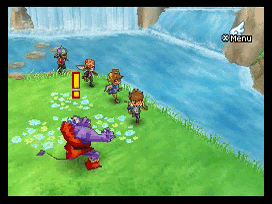
With a game like this, alternate control schemes aren't really possible.
            When the gimmick is valued more than the game design, developers may even opt to not include an alternate control scheme to simply push the platform.  A number of Nintendo DS games require the stylus to work.  However, a large number of games don’t.  Yet, some of these games, which were clearly designed without the use of a stylus in mind, force players to use the stylus based controls with no options to change them.  Magical Starsign is one of the most egregious offenders in this department.  It is a typical turn based RPG, which could very well have come out on the SNES or Playstation, however it is entirely controlled through the stylus.  Even though the controls would probably be more fluid with the d-pad, the gimmick is more important than functionality.  Wii games also suffer from this.  While Metroid Prime 3 is an outstanding game and really makes use of the Wii-mote to its fullest, the option to have a more standard control scheme is suspiciously absent.  It’s not as though it didn’t exist, as the previous two games had been on the gamecube with a regular controller.  It was purposefully held out to push the system.

            Gimmicks are not the only reason for not including alternate control schemes.  Just the most common one.  Complexity is another good excuse.  Many games have controls or actions that are so complex that to alter the buttons would break the game design.  In Okami, players hit a trigger button to freeze the game and bring up a paint brush.  Then, they use a face button and the control stick to paint on the screen.  To alter this entire sequence, which is used as often as ten times a minute in the game, would require the entire flow of the game to be altered.  It is a three layered sequence of events that requires enough input that it cannot be altered, in good conscience, without breaking the game.  This is a very common reason for a lack of alternative control schemes.  A game like Metal Gear Solid 4, which requires a player to get into a stance, line up their shot with a control stick, then fire with a trigger button, would be a nightmare trying to program alternate control schemes.  And it would ruin the game’s design.
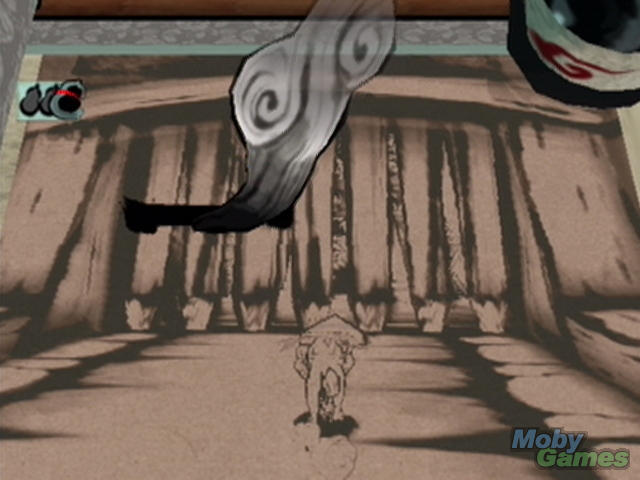
With actions that are complex or require specific commands, alternate controls would needlessly complicate the game.
            One of the more frustrating reasons for not including an alternate control scheme is the amount of contents in a game.  Many developers want to pack a ton of extra features into games, from side quests to minigames.  While a ton of content is usually very well received and helps a game in the long run, it leads to one phrase dominating design meetings.  “If we change the controls, we won’t be able to do everything we want to do.”  This might sound a bit selfish, but actually it is entirely reasonable.  Games like Jak and Daxter, Ratchet and Clank, and Sly Cooper, offer some customization of controls for the basic game.  However, complete customization would mean they would have to go into each and every one of their minigames, such as defending a beach with a turret, hacking a computer by playing pac-man, or running through a 2-d side scroller side mission, and change the controls each time.  Mini games would hurt arguably the most from this sort of implementation, but it would also rob games of their immersion.  Taking them out is not really an option either, since without the extra content the games would lose some of their variety.  Many designers can only choose one of the two, and in a pinch, they will choose content over customization of controls.
One minigame that lasts roughly a minute.  Imagine how difficult it would be to rebind controls for like a dozen of these in a 20 hour game.
            That brings us to the most frequently used reason for a lack of alternative control schemes.  Negligence.  Many game designers are either too strapped for time or simply do not think of them.  The games industry is a cutthroat business and developers who do not meet milestones are soon dead and buried.  The luxury of time to implement all the features that they may plan is not something most developers have.  They need to ship their product and recoup their money, because every month they have to sit on their game is tens if not hundreds of thousands of dollars lost.  So, the first feature to go is usually alternate control schemes.  If it’s thought of at all.  Many developers truly believe they’ve found the best control scheme for their game and don’t wish it changed or don’t believe it needs to be changed.  It is unfortunate that developers don’t take the minimal time needed to simply offer the option to rebind buttons and allow the controls to be rebound with them.  This is done frequently in quality assurance testing for developers, so simply giving gamers that option would be more than they’re used to.  However, when you’re in the crunch, you either don’t think of or don’t have time to implement such luxuries.

            All the same, despite the myriad reasons why developers do not embrace alternate control schemes more readily, even though they should, I remain hopeful.  Because, with indie gaming now in full swing, developers are more able to be flexible with their game design, including options for alternate controls, the ability to rebind keys, or supporting third party control systems.  The perfect example of this is the USB gamepad.  Logitech frequently releases USB gamepads that function just like a Playstation or Xbox controller, but which have drivers that enable it to have buttons bound to it in a certain way.  Games like Orcs Must Die, To the Moon, Wizorb, and PC ports of games like Silent Hill Homecoming or the Overlord games all include options for a gamepad as well as a keyboard and mouse.  And with the Logitech software, these gamepads are programmable to a degree.  Other games are realizing the importance of control and simply allow their entire command set to be rebound, like with Smite, which can have any control bound to any key on a keyboard, any button on a controller, or a combination of the two.
I have seen the future and it is usb controllers.
            Alternative control schemes are not dead and, thanks to modern technology, especially from modders making their own changes to games they love, they are starting to become more prevalent.  In this way, PC gaming is often more accurately described as superior to console gaming on sheer virtue of versatility.  If console developers wish to continue to be competitive, they need to make a product that is more accessible and more comfortable than, or at least on par with, their competitors in the PC market.  Unfortunately, with time, manpower, and costs for developing AAA games increasing, alternate control schemes may not be something the industry will readily embrace.
Rebindable controls like this make games so much more personal and enjoyable.
            As technology increases and functionality starts winning out over shipping a game by a certain date, I believe that alternative control schemes will become more prevalent.  And, as a result, I think that more people will find time for gaming, because they will be comfortable enough with the controls that they can enjoy the experience.  The future is not in fixed controls.  It’s in flexibility.  When there is a game built for two hands, but that allows a one armed man to play it with no handicaps, alternative control schemes will have really won the day.  And people will finally appreciate their USB controllers, the option menus in their favorite games, and the versatility of motion controls.  Until that day comes, keep on trying to find the control system that works for you.  And don’t let any developer tell you that what’s comfortable for you is the wrong way to play.

Thursday, September 6, 2012

AAA Illusion: Working to Create an Immersive Experience


It feels like all I do these days at the start of these posts is apologize…so I’m going to stop doing it.  Time’s going to pass, but I hope I don’t abandon this blog, because I think it is important.  With that said, let’s get right into it.

            On my last post, a friend commented on my discussion of games and limitations.  While they could understand my perspective and how limitations were important, they offered an interesting counter-argument and asked that I explore it.  The idea being that, as limitations became fewer and games became more powerful, they could create an immersive experience through far more advanced smoke and mirrors.  Using illusion, the game designers were able to craft an experience that was far more engaging than in previous gaming generations, where people could literally get lost in the game worlds.
If you want to craft an immersive game world, you can't rely on futuristic visors.  You need to rely on smart design choices.
            Appropriate examples of this were games like Skyrim, Dark Souls, or Half-Life 2, which offered rich, engrossing worlds that tried to make the player feel as if they were part of them.  As if they were real.  However, my friend also asked me to comment on one important aspect of these illusions.  They seldom ever hold up.  You see, for all the power of modern gaming, people still like to take short cuts or they make bad design decisions, or they just can’t check games as well as they should.  And this hurts the illusion they’re trying to sell and overall, the experience of the game.

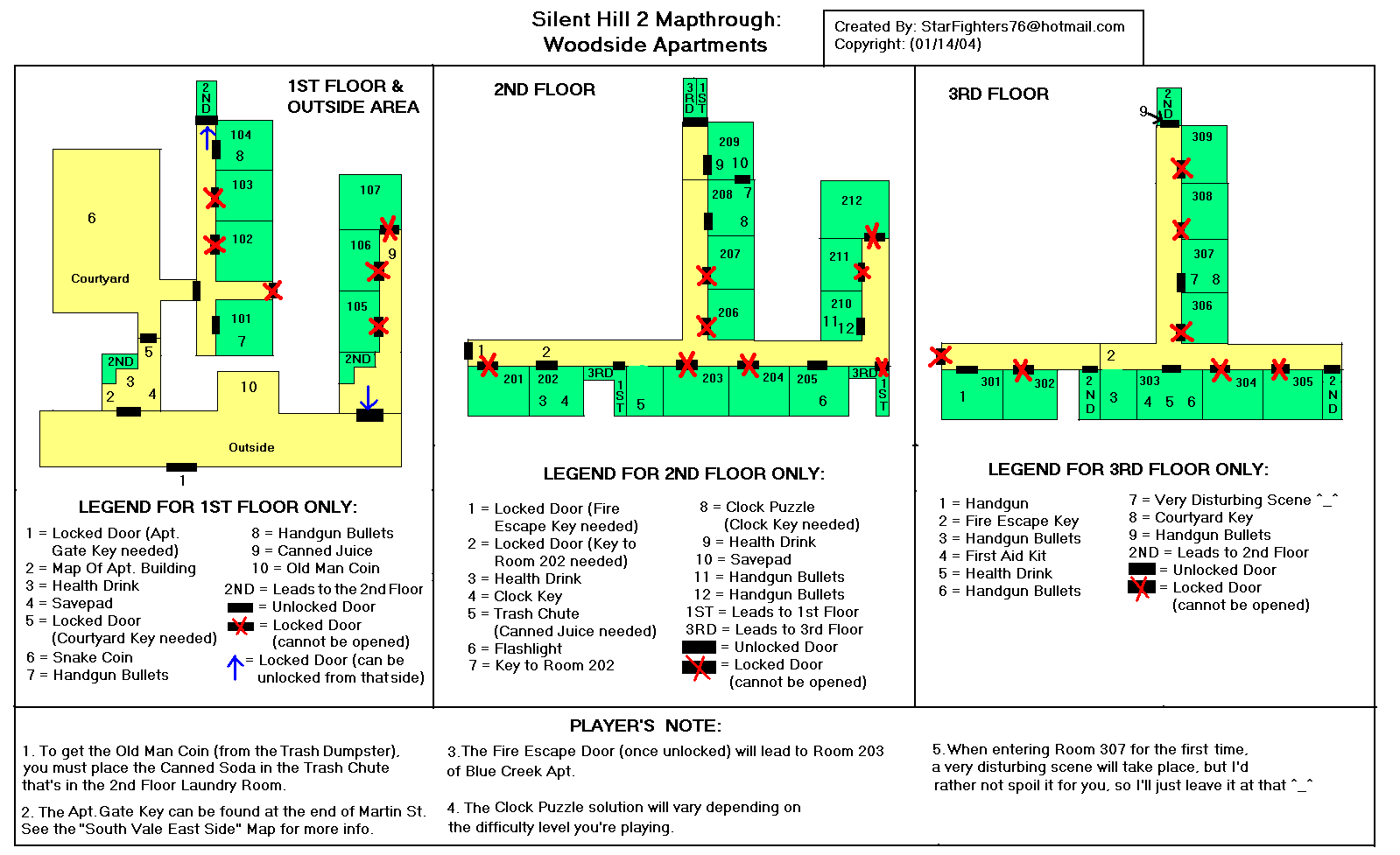
            Two perfect examples of this are the Grand Theft Auto games and the Silent Hill games.  While Silent Hill has always benefited from limited graphics, making monsters more unnerving and the environments more haunting, they can be incredibly frustrating for not selling their illusion.  In almost every Silent Hill game, a good 70-80% of all doors you see will be locked and unable to enter.  Now, this might make sense if it’s late at night and you’re in an office building or what have you…but if the buildings are abandoned or part of some demonic other world, why even put the doors there if they’re just going to be locked?  It’s like teasing the players with worlds they could explore, but can’t because the designers got lazy or ran out of money.
The floor plan for the apartment building in Silent Hill 2.  Note the obscene amount of X'ed out entrances.
            Likewise, in Grand Theft Auto, there are so many places people can go and things they can do, offering an illusion of real freedom, but the least explored part of the game?  The inside of buildings.  So much work is put into making the city look and feel alive however players see so many office buildings, shopping centers, car dealers, etc. and they can approach them on the outside, but often, they can’t go inside.  Same with Prototype or Infamous…there are so many places to explore outside, but the use of a door is a mystery to the main character.  And herein lies a big problem for modern gaming.  They are making design choices that simply aren’t immersive for the purpose of aesthetic value.  In a Silent Hill game, everything is tense because of all the doors and the dread of what could lurk behind them.  And in a GTA game, the city would look weird if it was just a whole bunch of walls with no doors.  Aesthetically, they aid the game’s atmosphere and overall look, however, they also hurt the illusion of a real world the game is trying to make.
Hey, hey!  See all those buildings?  Those windows?  Those doors?  Yeah...you're not allowed into those.
            To further demonstrate this idea, I want to look at three current generation games.  Skyrim, Xenoblade Chronicles, and Dark Souls.  The first two attempt to create a truly immersive world, but fail for relatively simple reasons, while the third actually manages to create a world that feels alive.  Starting off, Skyrim.  While one could argue about the aesthetic quality of the menus in the game, the user interface, character creation, and various abilities that the game allows players to indulge in, such as smithing, tanning, or alchemy, give it a feeling of freedom, as if the players are in total control of their destiny.  They can go anywhere and do anything.  However, Skyrim, big as it is, has limits.  And those limits tend to be invisible walls.  Skyrim is a game that suffers from the developers simply creating a box and saying, “You can’t go past here, even if you can see past it.”  Forests or mountains will simply have a wall where players cannot move past, even though they can see past it.  This happens far too often in sand box games.  Some can circumvent it, but when people simply choose to indulge in invisible walls, it greatly hurts the immersion.  And the many bugs, while amusing, also hurt the game’s realistic feel.  Seeing a dragon flying upside down or a mammoth floating in mid air might be fun the first time, but if it keeps happening, players will just continually be reminded that they are in a game…not in Skyrim.
Do I even need to say anything?  "You cannot go that way."  Really?!  Tcch...lazy invisible walls
  Xenoblade Chronicles, ironically, fails for almost completely opposite reasons.  It creates a lush, beautiful world for players to explore with tons of details, such as a giant, looming in the background that players will actually get to climb on.  And, more importantly, no invisible walls.  Players can jump, run, and swim nearly anywhere they can see.  Sometimes those jumps will be too much for them and the fall will kill them, but the point is, if their hit points are high enough, they can literally go anywhere.  The environments allow a true freedom of exploration that is free of bugs.  However, where the game fails is in the combat.  While the overall aesthetic is impressive, as character appearance changes with different armor and there are no random encounters, the gameplay is built like a faux MMORPG, which forces players to auto attack, rely on computer controlled AI, and spam their skills without really feeling in control of their character or their party.  The combat makes players very much aware that they are playing a game and this is heartbreaking.  For all the detail and immersive elements in the game, the combat just pulls players out of the experience.  It is sticky, slow, and teeth grindingly frustrating, as it is heavily focused on grinding.  However, rather than having one to one control like in a Dragon Quest game, the designers took control away from the players for this baffling choice of battle system.  There are also several “time saver” features, such as the ability to manipulate time to make it day or night whenever players feel like.  While this may aid in the unbelievably monotonous and boring quests in the game, it really hurts immersion.
See that scenery in the distance?  You can go to all of that.  There are no walls here.  Pity the combat sucks so hard.
 In my opinion, Dark Souls is probably one of the few games to create an immersive, illusory world that players can get lost in and invested in.  Made even more so by the online element.  Dark Souls features a world that, with a few exceptions, such as being warped to a new area, is completely interconnected, with varying shortcuts and ways to get around with no loading screens and, more importantly, no invisible walls.  No intentionally invisible walls at least.  The game does have several hidden walls that players can find however, anywhere a player can see, they can go.  And, they have one to one control over their character in the game.  What makes the game even more immersive is that players can encounter phantoms of other players, who will attack them, aid them, or leave them messages, creating a truly living world with other players who act like real people, sometimes leaving fake clues, helping out of kindness, or who act with malice for no other reason than they enjoy it.  The game isn’t perfect, as players who die of falling can get hung up on certain objects to humorous effect and there are a few spots here and there where, even if you can get to them, they impede your character when they really shouldn’t.  However, on the whole, Dark Souls offers one of the most immersive experiences in gaming, which is important, since there is very little story.  The game relies on its dark atmosphere and crushingly realistic design choices to sell the world.
Look at that level design.  You can go anywhere you can see, including off the ledge if you so choose.  Total freedom.  You know...until the game kills you.
 Now, looking at these three games, some tips can be gleaned.  First, if you’re going to make a game where players can go anywhere, don’t create an overly complicated battle system or one that removes control from the player.  It will only annoy them.  Second, if you want to release a big, immersive, sandbox type game, check it for bugs.  Check it.  And check it.  And check it again.  Patches might be needed to fix the game, but don’t use a future patch as an excuse or a crutch.  Make the game right the first time.  And finally, most importantly, make the game feel organic.  No invisible walls.  In Dark Souls, they have limitations in place but they’re not invisible.  Crevices, mountain walls, deep patches of water that players can see and that any respectably armored warrior would be unable to swim through all dot Dark Souls and they act as boundaries.  They are all visible and players know to test their limits at their own peril.  Skyrim, however, can have players going through a forest and hit a wall, even though nothing is in their way.  This is remarkably easy to fix.  For example: If you want to create a wall that separates Skyrim from other areas in the world, why not put a literal wall there.  Like a border guard that refuses anyone entry and cannot be opened from that side.  It creates a literal wall, teasing players about what’s beyond but also telling them that their goal lies within that wall.  Or, if you have an area bordering the ocean, create several cliffs around the edge.  Allow players to jump off the bluffs, but line it with jagged rocks.  They might die if they jump, but they’ll feel like the world is organic, as if they did that in real life it would have the same effect.  There are countless ways to make a world bounded, but in an organic way so that players do not notice how gamey it is.  Dark Souls may occasionally use warps, but they try to make them seem organic as well, such as having a crow or a gargoyle take players places rather than just a fade to black and a loading screen, something that even Xenoblade falls prey to at times, so that it seems like all the worlds are interconnected.  And while players need control over themselves, don’t let them control their world.  Don’t give them a weather controller or a timer feature.  They might think it’s cool and useful the first time they use it, but more often than not, they’ll eventually forget about it and using it again will only take them out of the game.
You want to create boundaries for the players?  Can't do better than an island.  Invisible walls not necessary.
 There is one other tip I have for game designers.  Put forth more effort.  I know game design is difficult.  Ridiculously so at times.  There are deadlines and changes that need to be made, testing for errors and recording voices or crafting cinematics and far too often the publisher can dictate additions to the game that may not make sense or which are far too time consuming to be reasonable.  However, if you are going to put three years into making a game, you may as well go all the way and make it as polished as possible.  Make the illusion complete.  Even if a room has to be copy pasted from others, that’s better than a locked door or one that’s painted onto a wall.  Now, not all games need to adhere to his.  Games like Culdcept Saga on the Xbox 360 have a distinctly gamey feel to them as part of their design.  They play similar to monopoly with a TCG element added in, so immersion is a non-issue with that kind of game.  However, if you’re trying to use illusion to create an immersive game experience then make sure the illusion is flawless.  Don’t get lazy.  Make the game world feel so real that players are literally scared of looking around them when they play a horror game or so intense that they can hear the birds and feel the breeze in an open world game.  Don’t put in invisible walls to save time rendering cliffs.  Don’t create battle or gameplay systems that are counter intuitive to the overall feel of the game just because it’s popular.  Don’t be satisfied with good enough.  If you’re going to create a world, create it the right way.
Nothing kills immersion like this crap.  Don't be lazy.  Close the gate, make the bridge broken, have a troupe of guards stopping you, do something!  Don't just say "Sorry, can't go this way any longer."
 This can be considered a big problem for modern gaming.  With the rise of technology, games have certainly become more beautiful, but they are also far more time consuming to create and thus, making a cliff or ten for Skyrim could take weeks, compared to adding in a room or two in Silent Hill which might only take a few days with existing resources.  On this, I can’t really offer any advice other than learn from the work of others.  Many games have preceded this current generation.  Some, like Half-Life and its sequel are truly immersive for different reasons.  Look at these games during the conceptual stages of game development and use them as a baseline for how to make the game world more engaging.  You don’t need to reinvent the wheel.  Learn from past mistakes.  Skyrim, for example, has the same invisible wall problems as its predecessor Oblivion.  If the developers had taken a lesson from their previous game and from fan feedback, they might have been able to rework the map of Skyrim a bit to solve the issue of walls.  Or in Xenoblade Chronicles, if you want a world without random encounters, why not look at other games that avoided them?  Chrono Trigger side stepped random encounters and even allowed players to battle without having to create a separate screen or interface for it.  Dragon Quest 8 and Blue Dragon from the previous and current generations respectively allowed enemies to be seen on the map screens before engaging them.  Developers may not play games as much as gamers do, but they should at the very least know their history and competition.  If their competitors or previous games have made use of a feature like theirs, learn from it.
Don't wanna break immersion?  Then random battles are not necessary.  But...be smart about it.
I know it is easy to say, “Well they should do this, it was better in this game, I’m smarter than you, etc.” and it might seem unfair or ungrateful for me to ask for more effort from already overworked and often underpaid game developers.  However, the truth is, if you want to make something that people have to pay for, you need to provide a better product.  The world is saturated with games right now, from the current and previous generations.  Dark Souls offered me an immersive experience that I managed to enjoy despite its frustration and while it was similar to games I’d played before, it went in a different direction that captivated me.  It was polished and even when I got frustrated, I still wanted to keep playing.  Xenoblade, by contrast, was heartbreakingly beautiful to watch, but was absolutely no fun to play.  The combat was so frustrating and took me out of the game so much that I gave up on trying to finish it because it simply wasn’t fun.  Why should I try to beat a game I don’t want to play, when I have at least five other games in my library that do what it does, but better?  I understand that game developers aren’t perfect.  They can make mistakes or overlook certain things, but at the same time, if I have to pay $50-$60 for a game, then I want my money’s worth.  I want something that I can enjoy, be immersed in, and not be taken out of.  I want illusion.  I want the game to tell me the perfect lie.  And, like with real life, if you’re caught in a lie…you ought to own up to it and have to suffer the consequences.  Above all other things though, I just want effort.  When looking at comic books, the critic Linkara said that sometimes poor design choices are ok.  That a lame idea can turn out great or at least decent in its execution.  And that sometimes, with a little common sense or research, a bad idea can be made better.  He stated that he didn’t want his comics to be re-written.  He just wanted good stories to be told.  He wanted effort.  And that is what I want.  If you’re going to try and sell me a world, don’t put up invisible walls or remove my ability to control my characters in combat.  Sell the illusion.  In this modern era of gaming, you can’t use limitations as an excuse.  Sell the illusion or don’t expect any of my money.