Showing posts with label Final Fantasy 13. Show all posts

Thursday, May 30, 2013

Month of Characters: Top 10 Villains I Hate For All The Wrong Reasons:


Well, anyone who knows me could probably guess that this was coming.  We have tons of great villains in games.  Well rounded villains who are relatable, lucid ones who are charming and brilliant, and the most scummy ones who you hate because of how evil they are.  However, here's the thing...when the story does it's job right, you hate the villain because that's the way it should be.  When the story screws up, you hate the villain because you want to smack the game designer and go "What were you thinking?!"  These are 10 villains I utterly despise, but for all the wrong reasons.  Needless to say, there will be spoilers.

SPOILER WARNING!!!


Satan(Castlevania Lords of Shadow)
I've talked about this one before, so do I really need to go on?  Satan as the final boss of a Castlevania game?!  I mean, c'mon...where's Dracula?!  But, for completeness sake, let me explain, again, why this is such a stupid decision.  First off, he's never been introduced, mentioned, or even hinted at throughout the 30+ hour game and we're supposed to care about fighting him at the end?  Bull crap.  I know lots of games sometimes do the fake out, where the main boss you've been fighting gets killed off and a new guy appears, but it does not make it any less stupid.  Also, if Satan is the head baddy, why would he kill one of the Lords of Shadow?  Because he kills the Lord of Necromancers right at the end of the game.  Finally, by killing the Lord of Necromancers, Satan ACCIDENTALLY SAVES YOUR LIFE.  Gabriel Belmont had been used and tricked by the Lord of Necromancers all game and had unwittingly come into contact with a possessed artifact that the Lord of Necromancers could use to kill him.  In fact, after you create the item you've been looking for the whole game, the God Mask, he uses the possessed artifact to start to kill Gabriel and take the mask as his own.  Then Satan kills him and suddenly, your possessed artifact no longer has a master, so bam, you're saved and you defeat Satan to win the game.  Evil would have won if the prince of darkness had butted out.  Just pathetic storytelling.  I mean, I was told for over 30 hours that the three Lords of Shadow were my opponents.  In fact, it's in the title!  Yet Satan comes out and just goes "Fooled ya!  I'm the final boss!"  That is just stupid to the utmost degree.

The unholy one is a banished servant of the divine.  He holds no power, despite believing himself deserving of greatness and is worth more pity than fear.
Geldoblame (Baten Kaitos series)
For most head scratching appearance, let's give it up for Emperor Geldoblame.  Throughout most of Baten Kaitos, he is manipulating powerful forces to gather together the pieces of an ancient god and use them to control the world.  Then he gets killed, betrayed by his partner who is smarter and more nihilistic than he is.  It was a satisfying end for the tyrant, out witted and with his ambitions in shambles.  Then, at the end of the game after the players have killed the elder god which was summoned and their homes which had been floating in the sky touch down on the earth, he appears again.  Geldoblame's giant head made of stone pops out of the ground and attacks the players in a battle they pretty much can't lose.  Why?  Why did this need to be here?  He had his moment, died for his hubris, but now we have to fight him again?  Why?!  Oh, so the whale can come here and restore the ocean or something, whatever, alright...it just feels wasteful and stupid.  Geldoblame was a decent villain...until he came back from the dead as a giant stone head.  Then I scratched my head and started hating him.
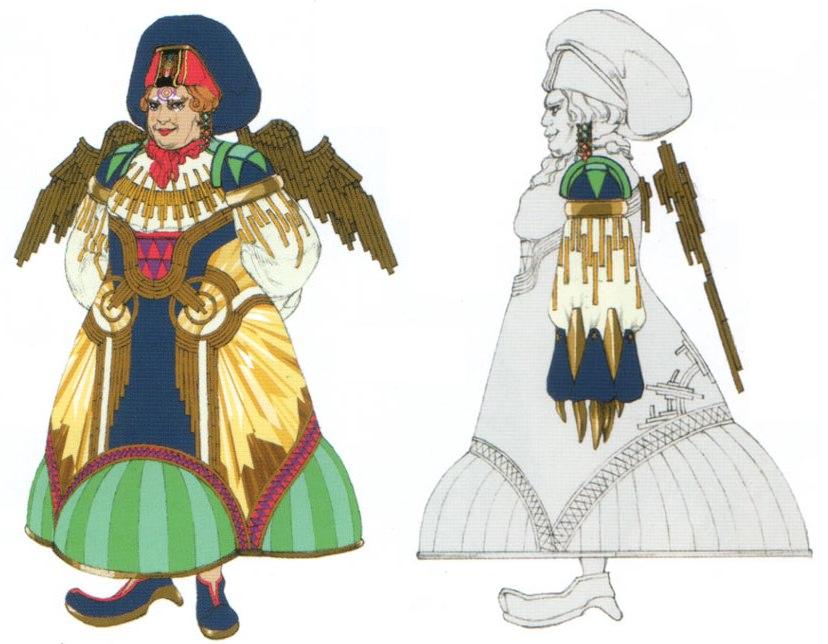
The emperor held great power and ambition, but was ultimately brought low by his own desires.  Despite that, he clung to life and the memory of the tyrant was replaced by the memory of a pitiful ghost who could not let go of his greed.
True form of King Allant (Demons Souls)
I hated Demons Souls.  For a lot of reasons.  But that aside, what annoyed me probably the most is the final boss, which is basically a slug-like form of King Allant, the man who unleashed catastrophe on his kingdom and basically started the game.  He sought power and unleashed a monster which merged with and ultimately corrupted him.  He's pathetically weak and can be slain in a single blow.  Now, I know why that is and I know why we should hate him.  We should hate him for his greed and arrogance and ultimately pity him, for in trying to gain power he doomed himself to a cursed half existence as a monster, alone in the chamber of the beast he made a deal with.  But really, I was so annoyed at all this.  I'd cursed, sweated, and struggled through the other dozen or so bosses, each a nightmare unto themselves, and my final battle was against the "False King" a truly wicked bastard who killed me a number of times before I dropped him.  And then I am told I must go fight the real monster, the mastermind behind the whole event, and it's just Allant after become a slug like monster?  What a freakin disappointment!  This, especially, after fighting my way through hundreds of lives to reach the ending.  Dark Souls, its sequel, has you fight the specter of a god who, despite having lost much of his power, can rip you apart if you're not careful.  Not the hardest boss in the game, but not easy, either.  A climactic battle is what players want, since it makes the ending we fought so hard for that much sweeter.  But for just being completely pathetic and ultimately leaving a bad taste in my mouth after such hard work, I hate King Allant.  He's the epitome of pathetic.

The hanged man was once a king.  However, his intense desire for power and his fear made him weak, pitiful, and ultimately destroyed him.  All that remains is a shell.  To slay him is a mercy.
Barthandelus (Final Fantasy 13)
I.  DESPISE.  Barthandelus.  He comes right out of nowhere, has motivations which are not only selfish, but utterly stupid, he's been spying on the party for most of the game, manipulating them, and wants them to destroy him and all of creation.  Why?  Because the creator of the Fal'cie went away and they're throwing a fit, so they want to call him back through mass genocide.  Worse is that Barthandelus kind of makes the entire story irrelevant, since the players are basically in the palm of his hand from the start and guided by him throughout the story.  However, this opens a huge number of plot holes.  How could he have predicted the players would be turned into L'cie with the power to destroy all of creation?  How could he have orchestrated it all when everyone's actions were a comedy of errors?  Why, if he wanted you to destroy him, do HIS soldiers try to corner and kill you for the first FORTY HOURS?!  I mean, what would have happened if we'd lost?  If YOUR soldiers actually cornered and killed us?  Did you ever think of that, Barthandelus?  For that matter, why doe HE fight the players?  He's basically a mechanical god, with immense power, yet he wants the players to kill him and destroy everything, right?  So, why does he fight?  Why not just lay down and take it?  The character is so bland, stupid, and frustratingly cliche.  Even if you forgive the plot holes, let's just examine the situation closely for one moment.  Despite watching over humanity for millenia, ruling them in luxury, and basically being worshipped as a god, Barthandelus wants the main party to set off the apocalypse by killing him just so he can call his creator back and "Start over".  Say that out loud for a moment.  Then, join me in saying, "Barthandelus, you are made of stupid."

The world ruled over all as a god since time immemorial.  However, even this was not enough for him.  He desired to return to nothing and start again, if only because he was bored, with no thought to those he would hurt or his children, which he would betray for his own petty desires.
The White Witch (Ni No Kuni)
This one is so easy it's kind of sad.  Ni No Kuni is subtitled "Wrath of the White Witch."  But despite the fact that the we see the witch "controlling things as a puppetmaster," she doesn't really do much and is pretty irrelevant to the story until the last...3-4 hours?  She runs a shadowy council and seems all intimidating and kills our hero Oliver's mom, but...she isn't the main villain.  Oliver and company don't even know she exists till she announces herself.  The main villain for most of the game is Shadar, the Dark Djinn, who has a much more tragic and satisfying backstory, far better reasons for being the villain, and a pay off at the end which is incredibly satisfying.  By the time I got to fight the White Witch, I felt like saying "Why are you here?  Bring back Shadar!"  She and her council are the final bosses, but they feel like they shouldn't even be in the game.  I mean, the plot could've been altered slightly to not include her and everything would've worked out fine.  Oh, White Witch...why do you even exist?

The priestess watched over the world from her gilded seat, unwilling to save it but more than willing to condemn it.  However, her vanity was such that she would not even rule it...instead giving that honor to her servant.  None know the priestess.  None care for the priestess.  The priestess need not be.
Maximillian (Growlanswer 2: The Sense of Justice)
Maximillian is actually a pretty interesting villain, but ultimately he feels shoved in at the last minute and has to be compared to the much more interesting monster named Gevas.  See, you meet Maximillian at the start of the game, you become friends, then, on a routine military expedition, you and he discover a cave with an ancient mask that he takes to go research.  Maximillian wants to rid the world of war and believes anything toward that goal is just.  At the end of the game, he finds that the mask is a subjugation artifact and that he can use it to mind control people into not fighting. And, for the sake of justice and free will, the player must stop him.  Here's the thing, though.  For most of the game, a character named Arrieta, with a dual personality, has acted as the main villain.  When cornered, she reveals herself to be possessed by Gevas, a world crushing monstrosity that the heroes of Growlanswer 1 fought and defeated.  Now it's returned and we have to fight it.  And after it's dead, we then go fight Maximillian.  To me, that just seems kinda pointless.  Not only did we defeat the ultimate evil, but we did it and the game didn't end...it only ends after we defeat Maximillian?  Lame.  Maximillian's plot and his final boss status seems kinda thrown in at the last moment, but they were alright.  They'd be fine if they didn't have to compare to Gevas, which we'd already beaten.  I hate this battle because the comparison just kills any tension, as Gevas was a far more final boss.
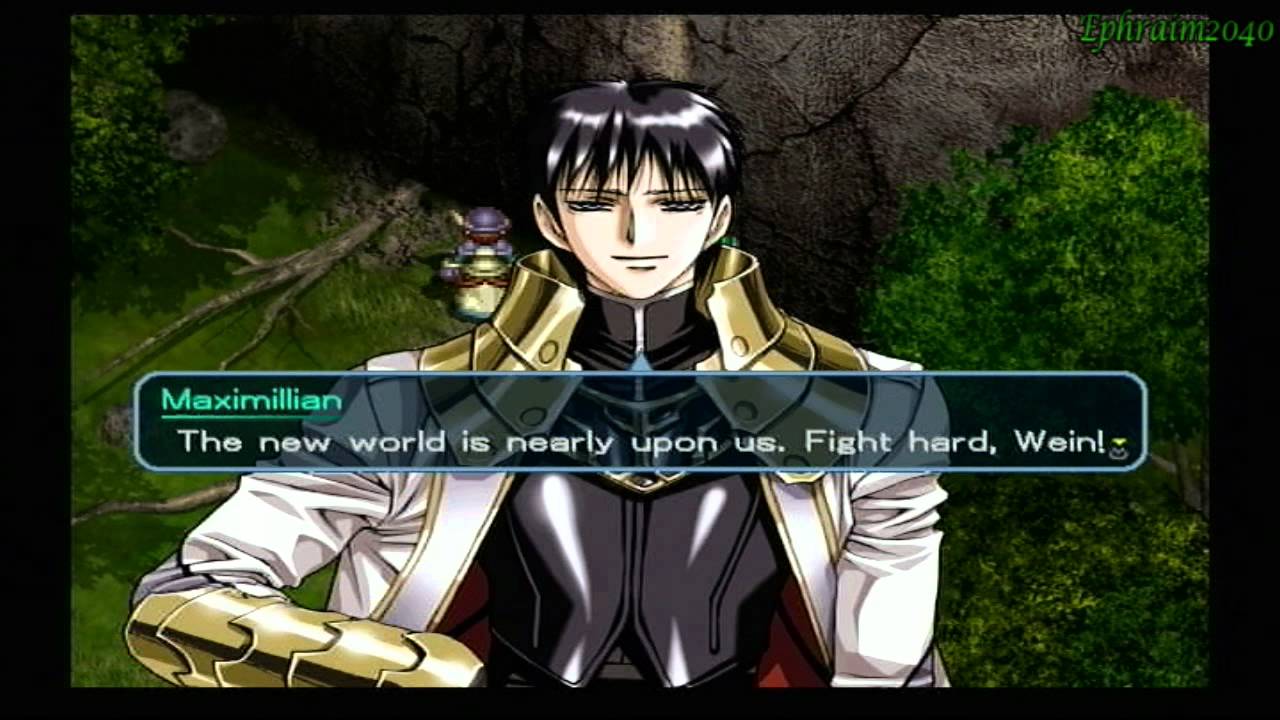
Judgement holds his answer as the truth above all others and will bring an end to the cycle of death and rebirth.  He seeks to end war, strife, and power, though his means be unjust.  The sad truth is that while he may judge, he holds no power compared to the vast will of the world.
Wilhelm (Xenosaga 3: Also Sprach Zarathustra)
Wilhelm is more baffling to me than hateful.  But, in a series with a ton of great villains, including the space pope, a man who blows his own head off, steps on it, then regenerates it, a body snatcher, and a space samurai, we have Wilhelm as the grand mastermind of some vaguely evil scheme.  Wilhelm is a CEO of a technology corporation in the far future, who looks to be about...age fifteen, tops, and has no emotions.  Or if he has them, he doesn't use them.  Wilhelm is boring.  And I have no idea why I'm fighting him, save that he's trying to...destroy the universe?  I guess?  And Wilhelm is the main villain.  He has private shock corps made up of better fallen villains.  He pisses me off because I have no reason to fight him, no reason to be invested, no reason to even care.  He's not even in the final battle.  He uses "The circle of Zarathustra" which I have no idea what its supposed to do, with a kid named Abel in the center, to try and kill the party.  Wilhelm seems about as bored as I am.  That's why I hate him.  The best thing a villain can be is memorable.  Some are memorable for good reasons, some for how lame or annoying they were, but they are still remembered.  The worst thing a villain can be is boring because no one will remember them.

The hermit does not indulge to enter the world.  He is content to stay back, emotionless, uninterested, holding his philosophy above all others.  There is nothing he has to say.  There is nothing he has to teach.  He may as well return to solitude.
Yu Yevon (Final Fantasy 10)
This villain is a thief.  As annoying and poncy as Seymour Guado was, he was still a pretty cruel, sadistic, nihilistic, evil villain, and fitting for the final boss role.  But no.  Instead, after fighting our way inside the colossal monster, SIN, which has rained untold destruction on the world, after putting Jecht to rest and outwitting the REAL villain, Seymour, we fight...a giant tick.  Yu Yevon was a summoner who formed the core of SIN by corrupting the summoned beasts, Aeons, and using them as an armor for its soul.  But Yu Yevon itself is nothing without the Aeons.  I doubt very much that its even capable of thought, much less malice.  It's a villain that was thrown into the final enemy slot because...I don't even know.  Players cannot lose the battles with Yu Yevon, no matter how weak they are.  What makes me so angry at this boss is that, despite how stupid he looked, Seymour was clearly the main villain.  And Square could have made him the final boss.  SIN was always a threat, yeah, but Yu Yevon wasn't really controlling it, just hiding inside it.  Yu Yevon is a pathetic waste of a boss, because he barely even exists and doesn't affect the story at all, save for stealing the final boss status from Seymour, who rightfully deserves it for all his dickish behavior.  Yu Yevon as a boss is a nonentity.  It's something that exists without reason.  That's even worse than being boring. 

The fool is a blind, deaf, idiot, dancing to his own tune, oblivious to the whims of others.  He may infuriate or annoy, but it matters not.  He is all sound and fury, ultimately accomplishing nothing, save for being a nuisance.
Xemnas (Kingdom Hearts 2)
Ultimately, I feel like miscasting was the downfall of Xemnas.  He's not really a bad villain, but he's so bland, generic, and boring that I can't help but yawn.  He uses his light saber swords, fights Sora and Riku, then disappears into nothingness, blah blah...we had so many other more interesting members of Organization 13 who could've taken the number 1 spot.  Saix was interesting and his relationship to Axel would've made him a moving final antagonist.  And his death, where he laments his lost heart and asks where it has gone is pretty heavy, for a villain dying.  If not him, why not Xigbar, who actually fought the original Keyblade masters in Birth by Sleep?  He seems more capable than Xemnas.  But no, Ansem's nobody had to be the final battle.  It depresses me because you do so many cool things in the battle, but Xemnas as a villain is so blah.  He's just there.  He doesn't make an impression like Xehanort did, doesn't have any really good lines and is constantly being one upped by his subordinates.  Xemnas.  So boring his battle almost killed me by putting me to sleep.

The nothingness holds no substance or value.  Merely a cheap copy of the truth, it has no reason to be here, save that it was recognized.  Though the idea of nothingness may intrigue others, it is without any lasting power.
Zachariah Comstock (Bioshock Infinite)
Originally, I had intended to include Demon King Malladus from Legend of Zelda: Spirit tracks...however, then I played Bioshock Infinite.  Literally the week before this post was to go up, I discovered one of the most frustrating and annoying villains I've ever seen in a video game.  Zachariah Comstock, the "prophet" of Columbia, a floating city in the sky.  I hate Comstock because, as a villain, I just want him to go away.  Not kill him, mind, I just want him to leave the story.  He is a loud, annoying, narcissistic, psychotically religious hypocrite with none of the charm and intellect of Andrew Ryan or the warped ideals of Sofia Lamb.  Comstock has NOTHING of value to say, but keeps going on and on about how he is the chosen one, how he will cleanse the sodom below, how everyone who is against him is against god, stock religious super villain nonsense.  And he seems so insecure, frequently building monuments the size of islands to his greatness when he cannot fight himself.  He's a frail old man who uses machines and his zealots, who are idiots for following him by the way, to do his dirty work for him.  At the best of times, he seems like he's using religion to his benefit, like any number of scam priests in stories.  At the worst of times, he seems pants on head insane, believing whole heartedly that stealing a baby from an alternate dimension, raising her in isolation, and frequently beating, torturing, maiming, and brainwashing her as an adult is somehow god's will and will save the world.  Comstock isn't compelling, intelligent, or even very well spoken.  He's an insane religious zealot with an inferiority complex.  Worse yet is that his character, when we learn the truth, makes absolutely no sense, as he actually didn't used to be Zachariah Comstock, but was another person.  A smart person.  A capable person.  A person who WASN'T pants on head insane.  Comstock ruined Bioshock Infinite for me.

The heirophant's arrogance knows no bounds.  He believes himself divinely blessed by god and will justify any atrocities in that name.  He says nothing of merit and is insecure in his own power.  Only a fool devoid of thought would follow his words.
            And there you have it.  These characters fail for a number of reasons, most relating to story and writing, sadly.  Any number of them could have been unforgettable main villains who embedded themselves in people's minds as amazing, well spoken, scary even, if they had a better script to work with or if the story was more refined.  Place Maximillion before the huge final boss battle...have Seymour Guado kill Yu Yevon and take his place inside SIN.  Have Satan at least HINTED at to some extent in the game.  Give Comstock ANYTHING interesting to discuss beyond how awesome it is to be a racist Catholic white man with a god complex.  These villains weren't brought low by our heroes.  They were brought low by the scriptwriters, the translators, and the story boarders who failed them.  Failed to make them compelling and instead opted for shock value or to cop out near the end of the game.

            There you have my month of characters.  Each of the character lists show an important aspect of the games industry, some that need to be focused on, like making compelling villains, admirable heroes, or great worlds to explore, and some that need to be stopped, such as making the villains so depressingly generic or unsatisfying.  Bear in mind, these characters are all just from my experience.  If you want, share in the comments some of your favorite heroes, villains, power fantasies, or characters you just can't stand and why.

Thursday, April 25, 2013

Where Did Final Fantasy Go Wrong? A Fan's Analysis


            Well, this is going to get a few people angry.  Anyway, this discussion came about because recently I've been replaying Final Fantasy 5, which is a criminally overlooked part of the series.  It, along with other older Final Fantasys and certain games from yesteryear, are a breath of fresh air compared to the modern industry.  However, the thought occurs to me that we could face a very real possibility of a FINAL Final Fantasy.  Square has abused the franchise to a surprising degree, milking it for all its worth while overlooking what made it great to begin with.  More worrying is that other companies, good companies with strong games and smart designers, seem to be following their example, hoping for similar sales numbers.  Level-5, for example, maker of excellent action RPGs on the PS2 such as Dark Cloud, Dark Cloud 2, and Rogue Galaxy, recently released the incredibly frustrating, poorly controlled, and much delayed White Knight Chronicles games and the beautiful, but flawed, Ni No Kuni.  They're ignoring some of the same aspects of game design that Square is, and with disastrous results, at least from this fan's perspective.  During the PS2 era, Level-5 was a name I trusted.  I would pre-order any game with their label.  Now, I dismissively wave them aside, because they've lost my trust.  Same with Square.  So, to see how we got here, I want to examine where Final Fantasy went wrong.

A reminder of times gone by.  The glory days of Final Fantasy are long gone.
            Before we discuss where Final Fantasy went wrong, though, we need to outline what made it such a seminal series for RPG fans.  This can be broken down into four main categories.  Graphics, Music and Sound, Game design, and Storytelling.  These four aspects of the game series are what enraptured fans.  First, let's examine why that was the case, then, we'll examine how Square dropped the ball.

            Graphics: Final Fantasy has always focused on graphical fidelity to a degree.  Even during its time on the NES, it tried to be a powerhouse of graphical design, using complex sprites, a varied color palette, locations that were relatively unique at the time, and a style distinctive from other games of similar design, like Dragon Quest or Phantasy Star.  As the series gained steam and moved on to the SNES, this not only meant crisper, more detailed graphics, but an improvement in how they were used.  Character sprites could now emote to a huge degree, showing shock, concern, anger, disgust, etc.  Mode 7 was also a popular feature for giving certain sections, like traveling via airship or on chocobo in Final Fantasy 6 a distinctive feel.  The graphics served a purpose of not only making the game prettier, but also of making it more unique and distinctive and allowing the characters to connect to the player on a visual as well as narrative level.  There was a lot more, "Showing" instead of "Telling."  When Final Fantasy came to the Playstation, there were some graphical hiccups, with the blocky style of Final Fantasy 7.  However, it still offered, at the time, gorgeous cut scenes, a distinctive style which, love it or hate it, has not been replicated since, and a more varied range of movement for characters.  They could wield weapons outside of combat, stand awkwardly, slump in place, etc.  There were a range of emotions that could be told through body language.  And this trend continued through Final Fantasy 8 and 9.  The graphic styles were distinctive, the cut scenes beautiful, and the characters emotive.

From the very beginning, Final Fantasy featured colorful worlds that pushed the limits of its platform
            Final Fantasy 10 is where I argue that the series started to get lazy.  I did still greatly enjoy Final Fantasy 10, however with the advent of voice actors, emoting became less important, and so the voices, which could often be quite annoying, became more apparent as opposed to how character models could be used.  That aside, the graphics were still quite good and allowed a much more interesting array of monsters and summoned beasts to be called upon.  This is true through Final Fantasy 11 and 12, which each had distinct styles and graphics which were quite pleasing to the eye.  Cut to Final Fantasy 13 and its sequels.  The graphics here plateaued, in my opinion.  They were as gorgeous as they could probably ever be and didn't really need improvement.  The character models are painstakingly detailed, the environments crisp, and even the style of monsters was varied too, giving them a more mechanized look, even if far too many enemies were just soldiers in drab uniforms.  However, I personally believe that the characters lost much of their ability to emote due to the game's over abundance of cut scenes, which basically plopped a pre-rendered mess into the game at certain points, but graphically, there shouldn't be that many complaints for the game.  From a purely aesthetic standpoint, Final Fantasy started out attracting players with a more graphically engaging RPG experience on the NES and this trend continues to the present day.  Square does, if nothing else, create beautiful graphics.  However, they have reached a plateau where they may not be able to wow us with graphical design any more and will need to find a new way to attract players, either through interesting graphical styles, like Final Fantasy 9 or 10, or by allowing the characters a wider range of expression.  Not just facial expression, but full body expression.

Even if body language has fallen by the wayside, Final Fantasy remains a gorgeous series with graphics that never fail to impress.
            Music and Sound:  Music from the Final Fantasy series is iconic.  It is soul stirring.  Hundreds of thousands if not millions of people have been brought to tears by themes like the "Aria di Mezzo Carattere" from Final Fantasy 6 or "Eyes on Me" from Final Fantasy 8.  And this has warranted dozens of full symphonic tours.  If graphics were the body of the series, music was the soul.  It moved players and that is one reason the older games are remembered so fondly, even though their music was limited by the hardware of the time period.

This music was burned into my brain from childhood.  I replayed Final Fantasy 6 at least a dozen times just to linger on this sequence and this score.
            I do not believe, personally, that any one series should be defined or held up by a single person.  Games are built by teams, after all.  However, Nobuo Uematsu, the composer for Final Fantasy 1-11 deserves personal mention.  While the series has been helmed largely by Hironobu Sakaguchi, most often uses Yoshitaka Amano or Tetsuya Nomura for graphical design, and has had a slew of other directors, animators, etc.  Uematsu was an integral part of the series.  Music from Final Fantasy 1-11 ran the gambit of light hearted and fun, to heartbreakingly tragic, to almost scary.  The music appealed to gamers on an emotional level and kept them gripped from beginning to end.  And, as the series moved from NES to SNES to Playstation, the music improved, as the sound chips and tools available to Uematsu improved.  Even now, he is recognized as one of, if not the, greatest video game composer of all times.

This man was the soul of Final Fantasy and his departure from Square crippled the series.
            And when Uematsu left Square, Final Fantasy lost its soul.  Square still owned many of the popular themes Uematsu created, such as "Victory Fanfare," "Mambo De Chocobo," "Prelude," and "Final Fantasy."  However, Square took to retooling or just ignoring these themes after Uematsu's departure, with few of them used in FF 12 and none, save for the Chocobo theme used in FF 13.  And that theme is so bastardized it's barely recognizable.  I will not say that the music got significantly worse after Uematsu stopped composing for Square, however it never stirred or gripped players like it used to.  It was passable, competent even, however the music lacked the soul and emotion Uematsu gave it.  Instead, Square has chosen to use more modern pop themes, the most used theme from Final Fantasy 13 being "My Hands" by Leona Lewis, an X-factor contestant.  Nevertheless, these themes COULD have held a place in the series if paired with Uematsu's music as a nice counterpoint, however as it stands, they feel like crass replacements.  Musically, Final Fantasy has become boring.  And if Square ever wants to recapture the previous soul, they either need to contract Mr. Uematsu to compose for them again, since he is now an independent composer, find someone who can create similarly evocative music, such as Yoko Shimomura or Akira Yamaoka, or stick with themes they already posses.  Final Fantasy will not get better if they ONLY use old music composed by Uematsu, but it may at least slow the degradation.  However, musically, it can't get much worse.  Bland is even worse than offensive at times in video games because it is forgettable.  At least offensive music sticks with you. 

I cut Final Fantasy X-2 a fair bit of slack, but that was a one off.  We didn't need pop music or bland themes in every game thereafter.
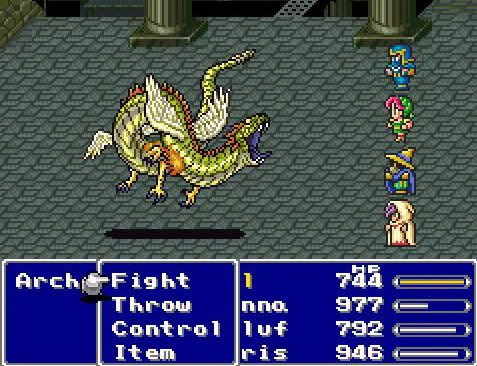
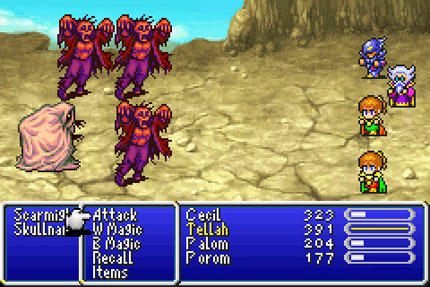
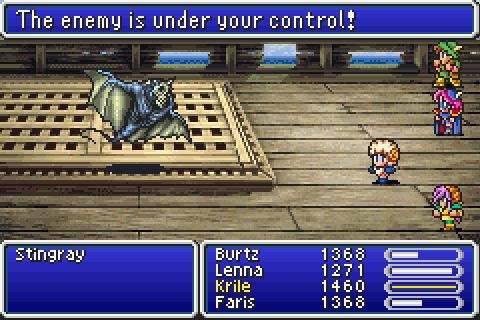
            Game Design:  Here we come to the key part of Final Fantasy.  Game Design.  The series is well known for starting off using turn based combat, then an active time battle system, and after many tweaks, a system not unlike those of MMOs.  Looking back at the original turn based combat, it was very stiff.  Battles progressed slowly, but that was because each character needed to be assigned a move, then perform it, then enemies did the same.  The active time battle system improved on this by speeding up combat.  Enemies and players could now have their turns intersect and whoever was fastest got to move first.  It allowed a great deal more excitement and tension in combat.  Then the shift to an MMO style took control away from all but one character, while still retaining the basic features of the active time battle system.

Say hello to the Active Time Battle System, staple of the good Final Fantasy games from 4-10.
            Ignoring combat for a moment, game design also had a great deal to do with how players experienced Final Fantasy.  Starting out on an overworld which allowed for non-linear exploration, players were given a path, told to follow, but allowed to deviate to find hidden treasures, new monsters, or just goof off and play with their abilities.  There were distinctive divides between overworld exploration, town based exploration, and dungeons.  Dungeons were dangerous and had plenty of enemies, but also lots of treasure.  Towns offered players a chance to buy items, hear rumors from NPCs and become immersed in the world.  Overworld exploration was the bridge between these two segments, giving the player the feeling that they could control where they moved not just in towns or dungeons, but everywhere.  This general structure would remain consistent with the series from Final Fantasy 1-10.  However, after Final Fantasy 10, the series tried to wean players off these features.  Final Fantasy 11 only gave players one character to control while still allowing them to have a non-linear world and job system to explore and play with.  Final Fantasy 12 still only had players controlling one character and made the game more linear, but the world was large, interconnected, and had branching paths which led to hidden secrets.  Final Fantasy 13 only had players control one character through a linear 60 hour hallway.  Even when the game supposedly opened up for exploration, there was very little in the way of secrets, hidden treasures, or anything really interesting to find.

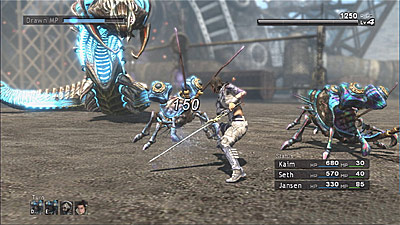
The MMO style of gameplay was not a good fit for Final Fantasy.  It robbed us of our freedom.
            What I want to make clear, however, is that linear exploration and changes to combat are not, in my opinion, what hurt Final Fantasy design wise.  The series has always been ready to explore and experiment with different styles of gameplay.  What irked me most was the general lack of control players had after Final Fantasy 10.  Control is what Square took away from players since Final Fantasy 11 and the series has never been the same.  Players controlled between 3 and 5 characters at a time before Final Fantasy 11, were given free range to explore wherever they wanted, and a wealth of other options were made available to them, from weapons and armor, to spells, summons, and personal abilities.  Final Fantasy 11 reduced the game so that each player controlled only one character.  To a degree, this made sense, as it was an MMO and the job system and constantly changing world allowed players to explore and experiment without the game getting stale.  However, Final Fantasy 12, which was not an MMO, also only gave control of one character to players, even though a party could have three characters and a guest.  The characters not in use by the player were AI controlled and had to be given orders beforehand using a series of logic loops called gambits.  While frustrating, at least these gambits gave players some semblance of control and Final Fantasy 12 had secrets to be found, like hidden summons, dungeons to revisit, bounties to hunt, etc.  Final Fantasy 13, however, was the nail in the coffin.  Only one character out of three could be directly controlled.  The others were handled by the computer.  While there is an illusion of choice, as you can select individual commands in battle, the computer is smart enough that if you hit auto battle, it will basically do what is necessary to win/survive.  There is some control in party layout, as each character has a few "jobs" with different abilities, however it all comes down to auto battle in the end.  Worse, players are given a 60 hour linear hallway to explore, with no secrets, no branching pathways, no towns, nothing that is not scripted.  It is like playing a 60 hour movie.  There were some attempts to restore control, like when players are allowed to explore for the first time some 40 hours in, but by then it was too late.  Gamers had already resigned themselves to the hallway.  Final Fantasy 13-2 seemed to understand this to a degree, and there are more places to explore nonlinearly, but the game still only allows control of one character at a time.

Here's a typical map from Final Fantasy 13.  A long hallway, with no branching paths, no exploration, no control.  This hallway was the nail in Final Fantasy 13's coffin.
            Final Fantasy was, at its core, a role playing experience and control is the heart of that experience.  You have to role play.  To feel like these characters are under your control and so their fates and yours are intertwined.  When you explore, they discover and when you make a mistake, they suffer.  Removing control essentially removes all elements of role playing from Final Fantasy.  A ROLE PLAYING GAME.  In previous iterations, job classes which players could customize to their taste were available.  Summons could be swapped, mixed, matched.  Skills could be learned and experimented with.  In Final Fantasy 10, the most enjoyable addition to the series was the ability to CONTROL summoned beasts, as well as swap out party members mid fight.  The level of control was staggering and it made players invested in seeing these characters succeed.  But, if control is removed and a computer can do the job of the player...why do we even need to play the game?  Where is the tension?  Where is the investment?  This is, in my opinion, the biggest misstep of the Final Fantasy series.  But not the last.

When it comes down to game design, control is the name of the game.
             Storytelling:  Storytelling is a prickly issue for Final Fantasy.  Despite how beloved the games' characters, stories, and twists are, they are also rather silly.  Nothing is too out there for Final Fantasy games, which frequently included steampunk elements, alien invasions, cloning, time distortion, dimensional travel, crossdressing, gods fighting mortals, etc.  I believe that one of the reasons people find the stories so enjoyable is because they were paced well, kept a decent mix between high tension and comedy relief, and offered a different story each time from what was expected.  True, many of the stories in Final Fantasy boil down to "Kill the evil wizard/swordsman/whatever" but the tweaks and twists added kept it interesting.  We dealt with something we knew, but in a manner that was wholly original to us.  How do you spice up a kill the evil wizard plot?  Throw him into the past so he can absorb ancient monsters to become a god and create a time loop.

Time Travel.  A sure-fire cure for boredom in a kill the evil wizard plot.
            Personally, I believe that the stories started to degrade in quality when voice acting was introduced.  It created a disconnect between player and character where if you didn't like a character's voice, that was too bad, you were stuck with it.  And while a player's imagination could fill in the gaps for a bad joke or an emotional moment in the previous games, from Final Fantasy 10 onwards, that job fell to the voice actors, and if they flubbed a line or made something awkward, that was how the story was.  There was no wiggle room.  As the games continued, voice acting was not the only problem.  Scripts generally became less coherent and focused more on melodrama rather than on actually telling a story that made sense and held together.  Worst of all, however, it would seem that the newer staff who replaced those working on the earlier Final Fantasy games, particularly the staff who worked on Final Fantasy 13, simply did not have a unified vision for the story they wanted to tell.  A number of times, there were leap of faith plot twists that were impossible to ignore, infuriating plot conveniences, and revelations that were head scratching.  Also, an encyclopedia was added to hammer out story details they couldn't bother to put in the narrative itself.  When you need an encyclopedia to explain a character's motivations or history, you are failing at storytelling.

This is not good storytelling.  This is the antithesis of good storytelling.
            What is truly a shame, however, is that most Final Fantasy games, even up to 13, had some interesting ideas to explore.  Interesting themes to be brought to light.  Final Fantasy 6, for example, looked into the idea of what would happen to the world if a capricious and nihilistic god ruled over it.  This outlook allow players to explore the issue of "if life is so short, so fragile, so fleeting, why bother?" and find some interesting viewpoints and reasons for why humans continue living.  Final Fantasy 10 examined how a world ruled by a corrupt theocracy could ultimately live in blind ignorance of the real monsters, even when it was being menaced by a creature the size of Godzilla as well as exploring the ephemeral nature of life and the power of dreams.  Final Fantasy 13, loathed though it is, looked at ideas of prejudice, how stereotypes and hatred can ultimately ruin a world, rotting it from the inside out, to where anyone associated with the accused are viewed as less than human by others and acts of brutality against them are deemed justified.  The true disappointment in Final Fantasy's storytelling was not that there were no good ideas.  The insane ideas and the deep themes practically made the story.  No, the true disappointment was in how poorly executed the story, and script, became over time.  They went from being a bit quirky and insane to almost totally nonsensical.
 
Final Fantasy 13 did have some amazingly powerful, moving character moments, exploring complex and mature themes...pity the story itself was so poorly told.
Conclusion:
            Looking at the data, it should be pretty clear what the major stumbling blocks for Final Fantasy are and why it's becoming less and less relevant to fans.  Graphically, there aren't really any problems.  Characters may not emote or use their body langauge as well in the HD age, but the series has always had a fairly high graphical pedigree and that's continued on into the current generation, with absolutely gorgeous vistas and backgrounds, interesting character and enemy design, and just tons of beautiful eye candy to amuse players. 

            Musically, the series lacks a strong hand to give it direction.  Uematsu provided that hand before and they haven't found anyone else to give it the necessary soul to match the onscreen events.  It hasn't become terrible overnight, but the slide has been gradual, with Final Fantasy 10-2 moving into more j-pop, Final Fantasy 12 trying to recapture the feel, but ultimately being a little forgettable, and Final Fantasy 13 being often times boring, annoying, or just confusing.  Why did they include an American Idol singer as a selling point?  Why license a song like that instead of having one made for the series by a strong composer? 

            From a storytelling perspective, the scripts seem to have gotten poorer and the over reliance on voice actors seems to be pushing scripts and dialogues into certain directions that ultimately make them less reliant on clever wordplay, body language, or situational context and more reliant on the talents of the VA.  This may be the world we live in, but you need a balance of those things, since not all VAs are created equally.  The nonsensical parts of Final Fantasy are, for the most part, fine.  The series has always had some goofy elements that don't make too much sense.  The important part is having a script which keeps players engaged until the game is over and they start realizing how damned goofy what they just played was.

            However, most importantly, Square needs to give players back control.  When you take away a player's control in a game, it stops being a game and becomes a movie.  Final Fantasy offered a huge amount of variety and control options until it hit 11, which limited it due to that game being an MMO.  After 11, though, all the single player games have been lacking in options.  Now, the norm is to only control 1 player where before a party of 3-5 could be under your control.  Restricting control is not a good idea, as it will remind players they are going through a very linear, scripted, and stifling experience.  Give players back the ability to make mistakes, since mistakes help us grow.  Give them the ability to explore, to talk to people, to shop, for god's sake!

Ironically Final Fantasy 13 sold very well...then, people realized it was crap and so sales dropped like a rock.
            And, there you have it.  They need a strong musical hand, a more balanced script that relies less on voice and more on context, words, and body language, and they need to give players back their control.  So, do I think Final Fantasy can recover from these pitfalls?  Well, it can, but I'm not sure it should.  Final Fantasy has always been a sort of industry standard for what an RPG is.  If people see this poor standard, they can at least learn from it.  Besides, Final Fantasy has already alienated a ton of fans, not just with flaws like the above in its main games but with numerous money grabbing schemes from its spin offs.  The brand is pretty weak right now.  It might just be better to start fresh, so to speak.  For example, Uematsu and Sakaguchi, both Final Fantasy Alumni, worked together to create The Last Story and Lost Odyssey, games which had a Final Fantasy feel, but which were not Final Fantasy, strictly speaking.  These games won over audiences with their graphics, music, storytelling, and above all else, their control.  So, a Last Story 2 or Lost Odyssey 2 might not be such a bad idea.  Start a new legend and let the Final Fantasy series have a break.  Better to let it rest in peace with over a dozen good titles than slowly wither and decay until there really is a "Final Fantasy."  And maybe someday, it'll be ready to come back.
 
It's possible that Final Fantasy has gone too far and will never be as it once was.
 
Even if Final Fantasy is gone for good, however, worthy successors have stepped forward.  The Last Story(Top image) and Lost Odyssey(Bottom image)
            Before I sign out, I would like to remind people that I am not an expert.  Just a gamer who knows what he likes, what other gamers like, and where the industry seems to be heading from my perspective.  This is just my opinion on what the hell happened to Final Fantasy.  Take it, leave it, or argue if you like.  Let me hear what you think happened.

Tuesday, April 16, 2013

Diminutive Diatribes: Encyclopedia Moronica

I'm preparing something special for May and working on my novel at the moment, so free time is a bit sparse.  I will probably have another full post before April is out, until then, please enjoy another diminutive diatribe.

Diminutive Diatribes: Encyclopedia Moronica


            In-game encyclopedias.  They take many forms throughout the game industry, from a journal entry which tells players what's happened up till the present, to a bestiary in an RPG, to dozens of terms which need to be explained, which aren't properly explained in the story, which players need to understand in order to know what the hell is going on.
While sometimes a useful tool, these aren't necessary to play video games.  And they never should be.
            Encyclopedias in games aren't always a bad thing.  Bestiaries can make great tools, alchemy guides can be very useful, and references to controls that you've learned but might have forgotten are essential if you need to put a game down for a long period of time.  However, too often in this day and age, games are using encyclopedias as a crutch.  They think that there's no reason to sit down and explain what's going on or what have you because it's easier to just throw a term out there and let the players do the work themselves to try and understand it.  Or worse, they are repositories of information that is necessary to understand the story, but which the game couldn't bother to tell itself, due to budget problems, disrupting the flow of the game, or just general laziness.
Encyclopedia and tools like them are useful, but they should never be made mandatory.
            Developers, take notice.  If you drop a term like Fal cie, necrology, nethicite, etc. but don't properly explain what it is...then you're just going to confuse and annoy your players.  If this term is important, then don't shove its definition into an encyclopedia in-game.  We have wikis online if we really want to know more about it.  If it's important, explain it to us, the players.  If it's not, then that negates the entire point of including an encyclopedia, because if it's not important, why should we care?  Why should we do YOUR job in trying to figure out what a term means when we paid you for this game?  And if these terms are essential to a story and you just dump them in an encyclopedia and tell us to research on our own, then you, the developer, have failed at storytelling.  You have failed at your job of telling us a story or explaining a concept.  And last I checked, if someone fails to do their job, they get fired.
This look of horror?  Yeah, it's what gamers get when they realize their game has more required reading than their school work.
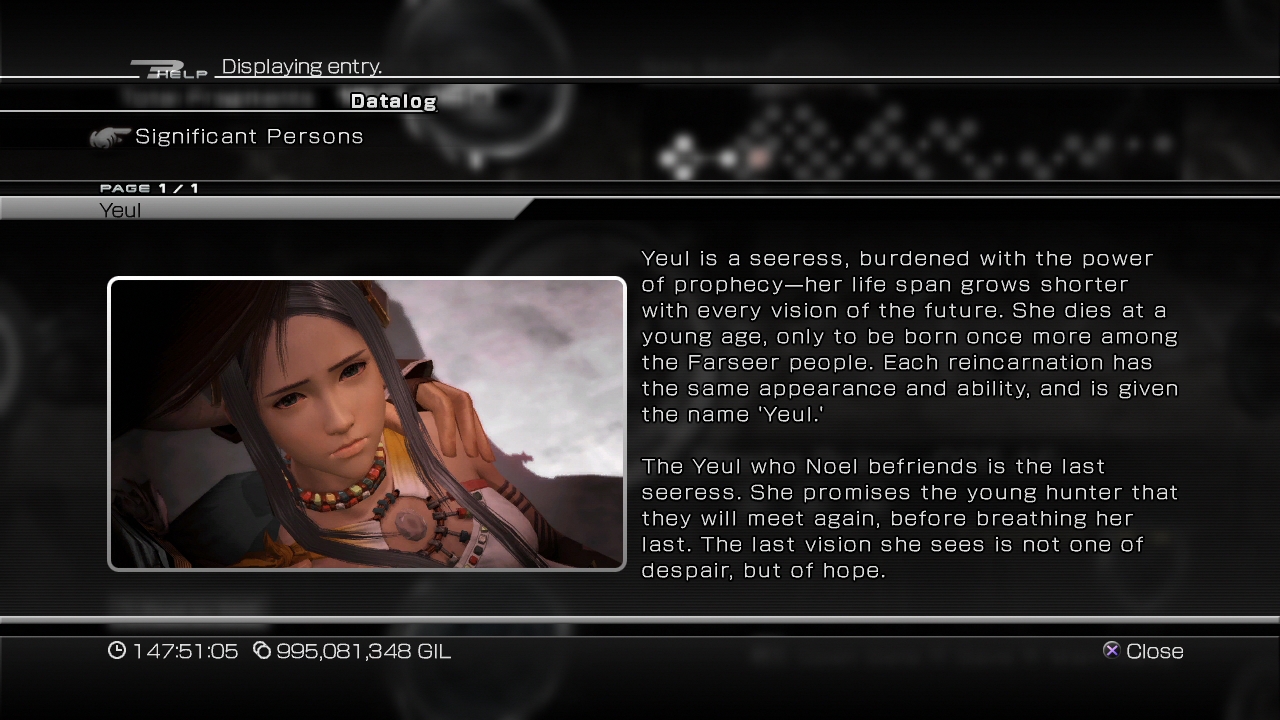
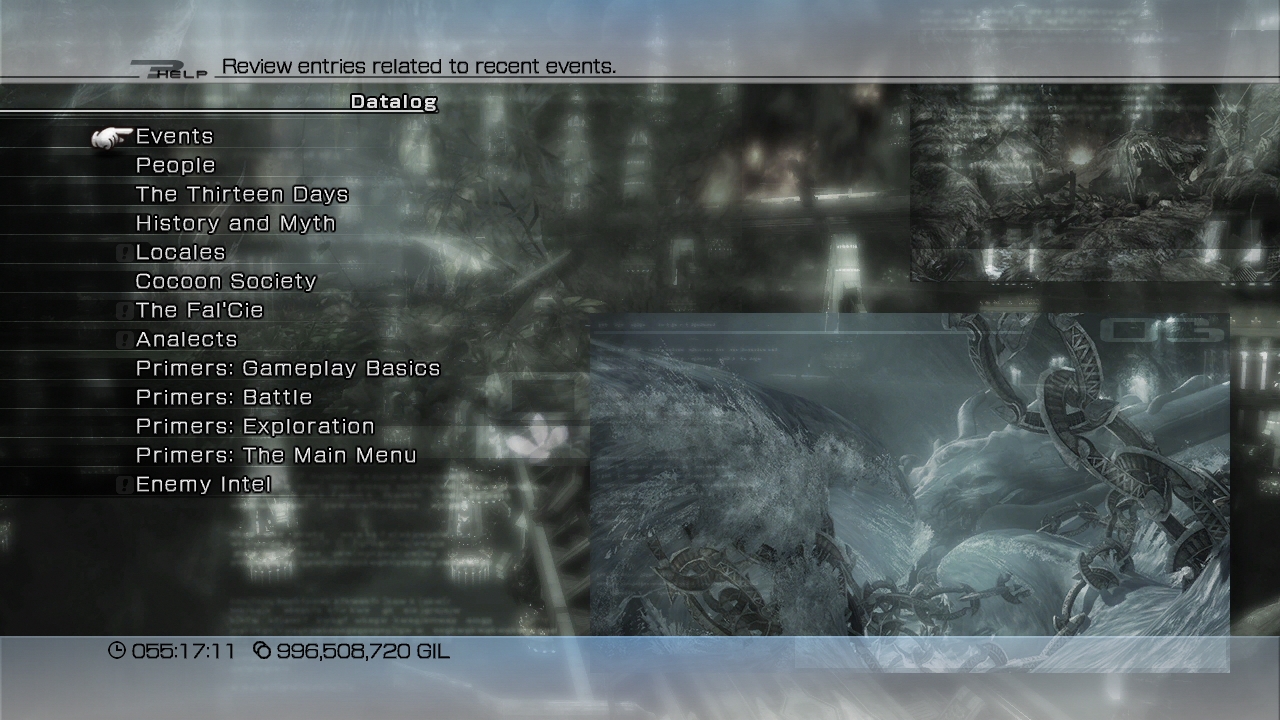
            Final Fantasy 13 is one of the most disgusting abusers of this principal.  It dumps huge blocks of terms from the game into an itemized list that takes hours to go through, slowing the game to even more of a crawl than it usually is.  Some biographies are included for characters, some with events we have seen and some which happened before the story, so if you want to understand everything then you have to read them all.  And some entries in this encyclopedia CHANGE over time, so you have to re-read them occasionally.  This is just a waste of time.  True, a number of these terms can be ignored, but some, like what a Fal Cie and a Lcie are can cripple the impact of the story if not explained.  The story tries to explain a few of the terms, but often times it leaves the player to discover who and what the gods of the world of Cocoon are and why they matter.  Who are the individual Fal Cie?  What impact do they have on the players or the world?  You'll never know unless you read!  And it is all explained in such a bland, annoying way, with a drab grey menu screen with nothing exciting about it at all.  This is the most moronic way to use an in-game encyclopedia.
Hope you enjoy grey menus and generic fonts.  Cause this datalog(encyclopedia) is going to take you hours to read.  And the reading is required.
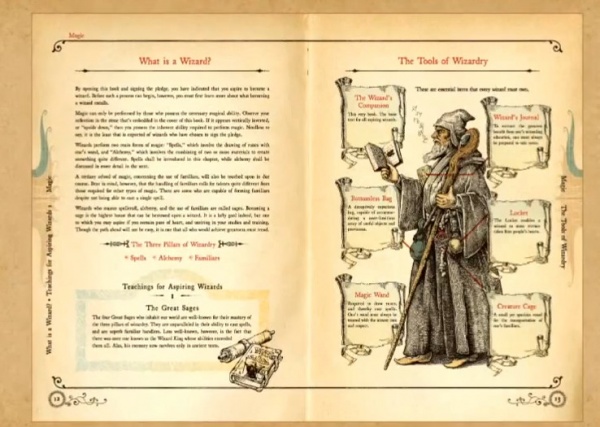
            If you want an encyclopedia in a game, if you MUST include it, then take a lesson from Ni No Kuni.  Ni No Kuni's encyclopedia is set up like an ancient wizarding tome, with colorful illustrations, an old timey paper look to it, and above all else, no obligation to read it if you don't want to.  It has a bestiary, an alchemy recipe list, item lists, spell lists, and a world map for reference.  That is the key word.  REFERENCE.  You don't need to look at it to play the game, but perhaps you want to know what skills a monster can use or where to buy an item?  Then you have your encyclopedia.  There are stories included in the book that aren't told anywhere else, such as the source of an eye in the sky which causes a storm or why your companion Mr. Drippy has a lantern in his nose.  However none of them are required reading.  They add to the world, certainly, but you can get by fine without reading them.  These phenomena are explained in-game, while more is there if you want it.  Mr. Drippy is a fairy and has a lantern attached to his nose because...fairies, am I right?  The eye in the sky creates a storm and is controlled by the bad guy, it's ancient magic.  Simple.  Why is the eye in the sky?  Well, you don't need to know, but if you want to, there's a story for it.  That's how to use an encyclopedia in-game.  It follows the logic of older titles like Wild Arms, Ultima 7, and Final Fantasy 6.  There are stories waiting to be found all about the world, told by npcs, hidden in bookcases, or just as side events.  They help add to the world, they help build it, but they aren't required to understand and appreciate the story.  There's two weapons in Final Fantasy 6, both called Atma weapon.  Do I need to know what they are?  Not really.  Can I find out if I want to?  Certainly.  What happened to Blackthorne in the Ultima universe after Ultima 5?  Do I need to know?  Nope.  But if I want to, I can find out.  The remake of Wild Arms for the Playstation 2 even includes an entire novella with interesting characters, plot twists, and high stakes...none of it is connected to the game and you don't need to look at it at all to win the game.  But if you take an interest, it's there for you.
You want to include an encyclopedia?  Make it interesting, make it unique, and most importantly, make it unnecessary.  Ni No Kuni nails this principle.  The Wizard's Companion is gorgeous.
            If you're going to include extra details in a game, be it journal entries, audio logs, letters, or an entire encyclopedia on the world, ask yourself two questions.  1) is it necessary?  If yes, then ask yourself if it flows along with the game or just takes players out of the experience.  If it takes them out of the experience, then you have a problem.  2) Is it enjoyable/fun?  Do these entries add to the world?  Do they make the experience something more?  If not, then why include it at all?  Extra details in a game should add to it, not make it a slog.
Encyclopedia-esque references have been in gaming for decades and aren't going anywhere.  But only in the era of the PS3 and Xbox 360 did they become mandatory.  This beautiful image is from a reference in Chrono Cross for the PS1.  You never had to look at this through the whole game.  But aren't you glad you did?  It's a stunning image.
            On the whole, still not sold on the idea of encyclopedias in games, but I recognize that they can be harmless or at least offer extra details for inquisitive minds.  I prefer those details to be woven into the game world organically, like finding an old man with a legend to share or reading a random book on a book shelf to hear about an ancient and tertiary conflict, but there's no harm in adding extra bits in the form of an encyclopedia entry.  However, they should never, ever be mandatory.  Slowing a game to a crawl because you need to learn about what the hell a bio-static electro gauntlets or a gravity discharge bomb is will only annoy players.  And annoyed players are more likely to avoid or abandon the game.