Sunday, March 16, 2014

Creator Spotlight: Kiyoshi Sakai


            If ever there were a developer I never expected to spotlight here, it would have to be Kiyoshi Sakai...mostly because I didn't know the name of the developer I had such admiration for until...about a month ago, when I was doing research on a game I dearly love.  Why am I spotlighting Sakai?  Two words.  Umihara Kawase.
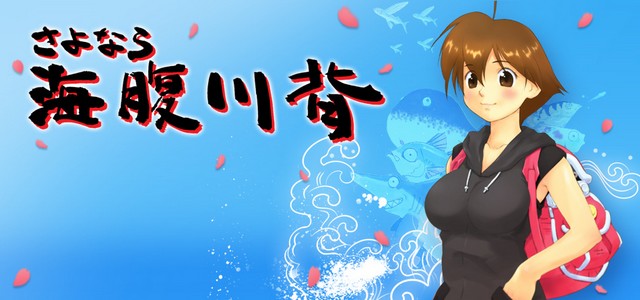
Kiyoshi Sakai has practically no pictures online, but Umihara Kawase is his child and his face in the gaming community.  So, ladies and gentleman, meet Umihara.
            Umihara Kawase is a small series of games based around young Umihara.  And yes, this was another Japanese only game introduced to me by the fantastic Justin Carmical, who showcased it in his second You Can Play This video.  I could go on and on about that, but we're here to talk about Kiyoshi Sakai.

            Sakai is the very definition of a niche/independent publisher.  Hardly well known, works typically in informal wear such as slacks or in apartments, and is rather shy in demeanor and very seldom makes appearances.  What I can say about Sakai, though, is that he is a damn fine programmer.  Sakai himself is quoted as saying, "I’m good at making complex game systems.  I designed the game myself, and I did it in a way where I could use my ability to come up with a complex game system. I built the game design around that skill."  Translation?  Sakai is able to program a system that is remarkably complex in it's execution, but very easy to use.  That being said, most of Sakai's games have an incredibly high skill ceiling, making experts on youtube seem akin to gaming gods.
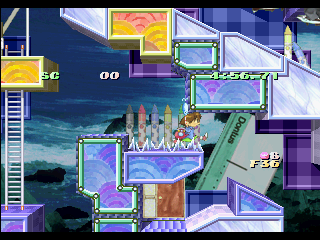
It takes skill to get to the bosses of the game and a ton of skill to survive them.
            Unlike most of my previous spotlights, Sakai has actually been around for a long time.  He got interested in game design due to his father buying a PC for work and he fiddled around with it, learning to program from there.  Sakai wanted to create something with his knowledge and this led to his career in game design.  He got started in the early 90s and his first commercial title as published in 1994, when the first Umihara Kawase game was released by NHK for the Super Famicom.  The game sold modestly well, but NHK faded into the background while Sakai's child, Umihara Kawase, lived on and had several sequels and ports.  Sakai himself is only credited as working on five games.  Four Umihara Kawase titles and the original Ape Escape.  Umihara is Sakai's legacy, as he created one game for the Super Famicom, one for the Playstation, one for the Nintendo DS, and his latest title for the Nintendo 3DS.  The PSP port of Umihara Kawase was made by an outside team.

            Now, I love Umihara Kawase, but it is damned hard...and I have Sakai to thank for that.  The game features a cute girl named Umihara in a strange otherworld in habited by fish who walk on land and strange larger than life items, like vegetables or bicycles.  Her only defense is her ability to jump, run, climb and use her elastic fishing pole, which she can use to reel in fish, or latch onto objects.  This is where Sakai comes in.  While he designed all the game mechanics on his own, what is jaw dropping is the physics engine.  See, Umihara can use her fishing pole to swing from ceilings or walls to try and get to new places.  Some of these swings are insanely hard, requiring momentum, precise angles, and a combination of the jumping and climbing mechanics on par with rom hacks, swinging from ceiling to ceiling with nothing but an ocean or a bed of spikes underneath.  For 1994, this physics system was amazing and has never been replicated except by, ironically, Sakai himself.  Like Bionic Commando, it features swinging from roofs and walls, however there is so much more finesse at play with Umihara, that I'd say the only comparable physics engine is actually in Portal, which uses momentum in a similar way.
Takes some out of the box thinking to make the physics engine work for you in this game.  It takes skill.
            What is perhaps more shocking is that Sakai hasn't worked on more games.  In fact, his Umihara games have been made by different studios each time, with the only real constants being himself and the series illustrator Toshinobu Kondo.  So, I want to give Sakai a bit of a spotlight for this amazing game system.  It is a testament to his talent as a developer that, for the Super Famicom, he created a physics engine on par with, if not better than, most modern ones.  Sakai doesn't really see any problem with a lack of recognition for himself or his series, though.  In fact, the most recent game in the series, Sayonara Umihara Kawase, seems to be closing the door on the series, and he's satisfied with how far it has come.  It would seem that Sakai saw game design and programming as a challenge and something that he enjoyed doing just for the hell of it, rather than getting rich off a franchise.  By his own admission, he built a prototype on his own and showed it to a friend who was working with NHK and asked if they could work together to make a video game out of it.  Despite this somewhat laid back appearance, Sakai has led the charge with all the Umihara games, being the visionary who has kept the series going.
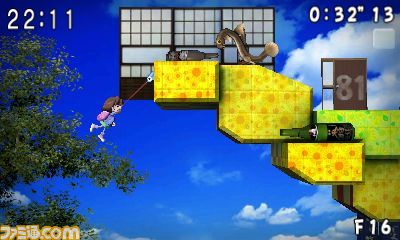
Yes, that's a giant radish and a huge tadpole.  No, I don't know why.
            If I had to give a complaint about Sakai, it's his lack of story focus and at times his informal demeanor.  In truth, Sakai himself admits that Umihara Kawase came to be because of a happy accident.  The games feature almost no story, despite Toshinobu Kondo's illustrations of Umihara and the world around her seemingly begging for a Miyazaki-esque fairy tale to provide context to the weird world of giant fish, oceans, and rivers.  It features some unusual imagery that does actually make players wonder...like in the original game, bicycles, vegetables, and certain other things that in Japan might be related to childhood or how in the sequel there are hints at a more grown up perspective, with pencils and school supplies dotting the landscape.  All the while, the background focuses on rivers and oceans, hinting at recreation and the imagery of another life that might be an obstacle for Umihara's enjoyment.  Even Umihara having fishing as a hobby was just because Sakai thought it would be cool for her to do that in order to make his mechanics work.  He didn't set out to make a fishing game at all.  Ostensibly there is no story and even the game's title, Sakai admits to creating just on a lark.  Umihara Kawase refers to the choice cuts of meat on fish, Ocean Stomach, River Back.  Kondo's illustrations beg for more context to this world...
Sakai, I wanted to know more about Umihara.  Please, tell me more.
            Umihara Kawase has never seen an English release, but in 2014, English speakers are going to get their first taste of it through Yumi's Odd Odyssey on the 3DS.  Honestly, I'm super excited, but I also hope it's not the end.  The game seems to have a story of sorts attached to it and it will be our first taste of some translated Umihara goodness.  For many, it will also be their introduction to the hardcore, but oddly satisfying mechanics that has become Sakai's hallmark.  I would like for more people to know about Umihara Kawase and Kiyoshi Sakai, because they're just fantastic, all over.
Sayonara Umihara Kawase on the 3DS, known in the States as Yumi's Odd Odyssey.  Check it out to witness Sakai's mastery in action.
            Kiyoshi Sakai has little information floating around the web about him, lacking even a proper wikipedia page, but there was an interview with him on USgamer and he is credited on Giant Bomb.  Umihara has little information about it, but to see it's madness and it's beauty, this youtube channel is the best way to go.  And please, support Umihara Kawase by buying Yumi's Odd Odyssey on the 3DS.  It's a digital download from the eshop and is well worth the price.  Give it a look!
Saturday, March 8, 2014

Diminutive Diatribes: The Game News Media's Double Edged Sword


                 I've made my disdain for the game news media and their hype machine preeeeeettty transparent in my past editorials.  However, even I can admit that they are a necessary part of video gaming culture.  I mean, without Kotaku spotlighting BrentalFloss or Laura Shigihara, they might never get thousands, if not tens of thousands, of fans.  Without the Escapist talking about a female game developer receiving harassment, how would we know?  And we do need to know.  We do.  Now, I have a complicated life...a frustrating life...and I don't like to deal with a lot of the drama of the world.  I know others who have a similar mindset and don't want to hear about some tragedy or some new thing to be scared of.  But we NEED to know.  At least in a cursory manner if not in a more indepth one.  Because if we live in a complete bubble, we're going to be left behind by the world and the people around us.
Games news media?  Essential.  Absolutely.  Both for our culture and for us as individuals.
            The game news media plays an important role in video game culture.  Hell, without Kotaku, Retroware TV, or any other game review/news media hub, people might not have ever known about Justin Carmical's tragic death or about the amazing work he tried to do for people.  We wouldn't know about the pros and cons of game consoles, we wouldn't know about the idiocy of companies like EA, the list just goes on.  HOWEVER, there is something that really grinds my gears about all this.  Editorializing.
Without news, a lot less of us would have known.  Even if we didn't want to know about his passing, we did need to know.
            Listen, I editorialize alot.  So do others on the sites I mentioned.  And, honestly, that's not really a big deal.  It can be fun, hearing a difference of opinion or being exposed to an idea that we haven't heard before.  As I've said, all opinions are important.  I actually tend to like editorials, like Ben Yahtzhee's Extra Punctuation or Kotaku's Random Encounters.  However, when we are relying on you to deliver the news...and you deliver an editorial...then we have a problem.

Whether they make you angry or not, an editorial is a clear as day, "this is my opinion" piece.  Just like this blog.  And that's not necessarily a bad thing.  Really, it's not.
            This may just be a personal preference, but every time, every post I see, basically playing Fox News with Nintendo, treating it's recent turn of bad Wii U sales as the end of the world, I get angry.  Because, you're putting either your viewpoint into an article that didn't really need it, because it's news, not an editorial, or you're trying to drum up views by sensationalizing the news.  That's not good.  Anyone who has seen modern news programming knows that they try to scare the ever loving crap out of their audience so they will keep watching...this has even begun to bleed into games media...and I hate it.

            Going back to Nintendo, Kotaku seems to have a particular dislike for it.  Blistered Thumbs had a similar disdain for the Xbox One...now, you're allowed to, in an editorial.  Editorials are basically our opinions put to paper to share.  But we DEPEND on you guys for the news.  We need to know if Dark Souls 2 is gonna be delayed or if the Wii U has lost more 3rd party support.  But what we don't need is all the fear mongering or sensationalism or hatred that gets added in.  Yes, Nintendo has had a bad time with the Wii U.  Know what else had a bad time?  The Gamecube.  What was that succeeded by?  THE WII.  You know, last generation's machine that practically printed money...why do you feel the need to make us believe Nintendo has ended in a NEWS article?

This and the controversy surrounding it?  Yeah, we need to know.  We rely on news.  So, why does so much of that news sound like a thinly veiled editorial?
            Point of all this discussion is that the games news media is a double edged sword.  We need it.  We need it to know if our rights are being suppressed by Congress, Youtube, or if one of our own, like Total Biscuit, are being harassed by an unscrupulous developer, so we can rally together and fight.  We need to know that women are being harassed so that we can tell people to knock that off and hopefully grow as an industry.  We need to know that the Wii U has had crappy sales and that this might affect it's future with other developers.  What we don't need to know is that you think Nintendo is dead, that women gamers are being butthurt, or that the world will end tomorrow if we don't fight SOPA and PIPA.  In news, we need facts...not wild speculation or opinion.  But we're human...so that's almost certainly what we're going to get.  It's almost impossible to divorce our opinions from any piece of news, especially when we're reading it.  And so, we have this eternal conundrum.  Game news media is the sword we use to defend our medium, but also the razor we use to cut ourselves in the bathroom.

            What can be done to solve this problem?  I honestly have no idea.  That's why this is a shorter discussion.  There ISN'T really a solution to this.  I mean, the best I can suggest is that people remember that these news pieces aren't the word of god.  They are biased.  They have people behind them.  So, take them with a grain of salt.  If you can remember that, then perhaps you can whether the promises of net neutrality dying, Nintendo going third party, or the Xbone being the first console to be dead on arrival.  Because these are just speculation...not fact.  And for the games news media, I just have to ask...try not to be Fox News.  Try not to sensationalize things for the sake of views.  Try and think about what you would think reading a news article that you've written.  How it would make you feel.  Don't try to spread anger or fear.  If we're going to grow up as an industry, anger and fear aren't what we need.  Reason, rationality, calm, etc. are.  Passion is grand.  Vitriol is horrific.

The sad thing is that even the article talking about Mario and microtransactions admits this is hearsay and that the talk of this is nothing new.  Then why did you need to report on it and spread anger/fear?
And also, please, know that you don't need to report on everything.  Games news media is like any news media...it feels like if it doesn't have a story, then we won't listen.  Maybe.  But we won't go away either.  We need you...so don't feel like you need to pad out your pages with articles that either don't matter or are just mean spirited.  Perhaps my favorite examples of this are, the Attack on Titan Burgers are disgusting (1, not your call, some of us might like them, 2, Really?  You really had nothing else to report on?) or the random person somewhat affiliated with Nintendo talked about making a microtransaction so that Mario could have a higher jump.  Why do we need to know or care about a hamburger marketed on an anime?  Why should we care about someone spouting rumors who probably has no power to influence what Nintendo says or does?  Answer...we don't and we shouldn't...but news media sites need their views.
Did we really need to know this exists, Kotaku?  I mean, really...you know, a slow news day isn't the end of the world.

            Like I said.  Stay vigilant and take all these "news" articles with a grain of salt.  More often than not, there's a subtext there.  Don't be taken in by it.  It kinda sucks that we, the consumers, have to pick up the slack for a vitriolic or fear mongering media machine, but...we NEED the news.  So, I think for the moment, that's how it has to be.  Maybe in the future it won't be like that.  We can always hope, right?

                             Believe none of what you hear and only half of what you see
                                                                                    -Benjamin Franklin

Sunday, March 2, 2014

Creator Spotlight: Laura Shigihara


            Confession time.  I got the idea for the Creator Spotlight section of this blog almost entirely due to one person.  I rediscovered her work just a little while ago, and I'd been a huge fan for years before...not really sure how or why I forgot about it.  She reminded me of other great game creators that I respected...and I wanted to pay my dues to them.
Too often people get angry at developers and creators who don't deserve it.  I want to pay respects to people rather than getting angry at them.
            From the title, it ought to be obvious who I'm talking about, but let me just give a brief introduction.  A fantastic pianist and vocalist, capable of singing both in English and Japanese, and a member of the prestigious club of 3 composers who have actually made me break down and cry from playing a video game.  This is Laura Shigihara.

Talented to a fault, but also very humble, enthusiastic, and adorable, Laura Shigihara is one of a kind.
 
Laura on Youtube.  Check her out.  CHECK HER OUT NOW!!!
            While not nearly as obscure as Amon26, I don't believe Shigihara gets nearly enough credit.  True, she has had some mainstream recognition from her work on Plants Vs Zombies, Plants Vs Zombies 2, and thanks to Kotaku spotlighting her collaborations and covers of other video game music.  However, she's not a household name when...really, I believe she should be.  Shigihara may be relatively new to the composing scene compared to Uematsu, Mitsuda, Talarico, or Yamaoka, but that doesn't make her any less talented or worthy of praise.

Shigihara has also worked on this charity album with such great composers as Uematsu, Mitsuda,a nd Yamaoka...eerie, isn't it?
            There's something undeniably charming about Laura Shigihara that is apparent anytime she creates her music and talks to the audience.  She appears to be both humble and enthusiastic about her work, showing a true reverence and respect for gaming as a whole.  Her first soundtrack composition was for the small casual game Wobbly Bobbly, which she offered to do for free just because she was so excited to be working on a video game.  Such dedication shines through all her work and it has gained her employment on a number of games, including Minecraft, World of Warcraft, Basement Collection, and my personal favorite, To The Moon.

Wobbly Bobbly, the debut of a great composer.
            I first came across Shigihara's work when I played Plant's Vs Zombies.  She not only composed the entire sound track and was the sound designer on the game, but was also the vocalist, in English and Japanese, for the end theme, Zombie on your Lawn.  The song and music video were featured on Steam and the deciding factor in my purchase of the game.  However, I only really took notice of Laura Shigihara while playing the indie game, To The Moon.

            In To The Moon, Shigihara's music made for a fantastic emotional rollercoaster.  It could be quiet and somber, a little manic or silly for the lighter moments, or even bombastic in places.  What got me, though, was the song Everything's Alright.  This is sung at a key moment in To The Moon where love, true, unrequited love, is lost.  I first heard it when I was in a...less than stellar relationship.  I won't spoil the payoff, but it was beautiful, moving, and heartbreaking all in one.  For me, this piece was something sad, but also somewhat hopeful.  It was an anthem to me of love and became both the hope and the requiem of my own hopeless romance.  Even though my love is dead, I still listen to it frequently and never tire of the soft, thoughtful look at a flawed relationship that we want to work so well.
             I suppose that's what made me really sit up and pay attention.  You see, this song, and Shigihara's music as a whole, remind me of a saying from the game Soul Blazer.  The gist of it is that music is a funny kind of thing.  The same music we listen to can feel very triumphant or joyous when we are happy, or mournful and sad when we are depressed.  It spoke to me, I suppose you could say.  It made me feel.  Any game and any music that can do that, really make you feel something, is powerful.

Yeah...that's the moment.  The moment music begins to make you feel.
            Shigihara's music usually involves the piano as she is incredibly skilled as a pianist, but it doesn't have to.  Thanks to the advent of sound software and electronic keyboards, a piano can produce a much wider variety of sounds, which offer great variety to the music as a whole.  Which is quite good, as Shigihara's strength is in piano music and vocals.  She often collaborates with others when other instruments are needed, which have led to some fantastic renditions of classic video game music.

            Now, I am not an expert in music or composition by any means, so perhaps this is also pretty normal for those who can play.  However, Shigihara amazes me with her ability to play music by ear and compose her own original pieces.  Her original work can span any range, from being soft, quiet, and mournful, to being fast paced and energetic.  Cubeland, From the Ground Up, and Jump showcase this range and all her songs are immediately infectious and memorable.  I also can't forget when I saw her playing the Little Nemo themes by ear on her piano.  It sounded spot on and was a wonderful nostalgia trip for me.

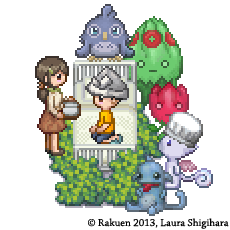
            Shigihara is an amazing composer in her own right, however she has also dabbled in game design.  While work began on an RPG called Melolune, it never made it past the demo phase.  However a 3 hour demo is quite impressive, nonetheless and Shigihara has stated she is only on break from this game.  At the moment, she is working on a title called Rakuen, which focuses on a mother and son's relationship, and how stories told to the hospital bound boy are able to help him cope with his illness.  Along the way, the boy starts to learn about the patients in the hospital and tries to complete his own sets of challenges to meet the guardian of the forest from his stories, the mysterious Morizora.  Having heard some of the soundtrack for Rakuen, I can say it looks to be charming and playful, yet also a little somber, mysterious, and possibly even tragic.  In short, it sounds like an emotional journey that I can't wait to try.

Fantasy and reality mixing to create a journey of emotions.  Also, I want that kids hat.
            While I have many famous composers I admire, including Nobuo Uematsu, Akira Yamaoka, and Yasunori Mitsuda, I'd say Laura Shigihara deserves a place among the best of them.  Her music is hauntingly beautiful, memorable, and something that everyone, not just video gamers, should listen to.

Laura is also very vocal about her love of gaming.  She defends the works of others and is a voice of reason in the vitriol fueled games media machine.
            For more information on Shigihara's game, Rakuen, check here.  For all Shigihara's music, which you can purchase for a nominal fee, check here for her bandcamp page.  If you want to show some support, then check out her blog or her facebook pages, but above all else, look at her Youtube channel.  It features some beautiful covers of music, from Miyazaki and Megaman to Frozen and Final Fantasy.  And, just to cover all bases, for the EXCELLENT To The Moon, and other great emotional journeys, check here.

            We don't get composers like her everyday.  No matter what the future brings, we're all anxiously waiting to see what you come up with, Laura.  Keep on playing, keep on singing, keep on having fun.

Keep on making that wonderful music, you beautiful person.

Sunday, February 23, 2014

Failure of Mechanics: The Hype machine and The Difference Between a Solid Game and a Broken Game


Phew...been a crazy week.  Still, I am doing my damndest to keep up with my promise and update at least once a week.  I have a full article written from a few weeks ago, polished, and ready for your perusal.  Next week, probably another Creator Spotlight.  Enjoy.


           Let's talk a bit about the games media hype machine and the general misconceptions of the gaming public.  Now, I know this sounds a bit bland, but...just follow me on this for a second.  I mentioned in my earlier reflections on the previous console generation that the hype machine is a big problem.  It creates unrealistic expectations of a game that will almost always be disappointing to gamers because the reality cannot live up to the hype.  The big problem with this, however, is that it creates misconceptions.  You see, too often gamers don't understand the difference between a solid title that, whether you like it or not, is at least a game that works, as opposed to a title that is broken on a fundamental level but which is still looked upon fondly because of the hype machine.

Yeah, the game's media hype machine promised us this broken pile of excrement would be awesome right up until release...no wonder people were pissed off when it failed so hare.
            Let me start this discussion by talking about Final Fantasy 4: After Years, for the Wii.  This game is REVILED by the gaming public.  Partially, I think, because of the hype machine.  The game was advertised on Kotaku and other gaming media outlets as the next great Final Fantasy game, the sequel to the landmarked Final Fantasy 4.  So...was the game great?  Well, no, not really.  However, that didn't make it an unplayable, unsaveable, or even a bad game.  What was Final Fantasy 4: After Years?  It was a decent little RPG that was originally developed as a cell phone title.  It used the same basic battle system as Final Fantasy 4, the active time battle system, however it added a few new features to the mix.  There was a combo system that allowed different characters to work together to create new attacks that were both unique and allowed for a bit of graphical flair in what was ostensibly a 16-bit throwback, there was a system with phases of the moon which affected combat, and there were extra dungeons unique for each character to play through that relied on their unique abilities to survive.  New characters were added to the roster from the Final Fantasy 4 cast and there was a new take on the story that had begun in Final Fantasy 4.  The game was, by and large, fully functional and had several interesting features.  The story featured the return of Golbez, the son of Cecil and Rosa, expanded on the mythos of the crystals, and added a few easter eggs from previous Final Fantasy games.  However, this game is hated by the Final Fantasy community, by and large.  Declared the worst in the series by many.  Worse than FF13.  Worse than Final Fantasy Mystic Quest.  Worse than Final Fantasy 14 at it's broken launch.  But was it?

The irony is that for all the shit FF4: After Years gets, if it had been released in 1995, it would have been a mega smash hit and remembered as a classic.
             No.  I stand firm and declare that while Final Fantasy 4: After years did have several flaws, namely that it was a bit too nostalgic and loved revisiting locations from Final Fantasy 4, it was originally a cell phone game so was sold piecemeal when first released, and that the story deviated from the basic tone of the original Final Fantasy 4, it was not a bad game.  The game was, from a mechanical standpoint, relatively sound.  There were some issues with the delivery of the game, as it was sold in individual episodes before being collected, but the battle system, the music, the graphics, everything that made the game "a game" worked and it worked well.  So, argue for whether or not this is a good game all you want, but don't decry it as the worst game ever, because like it or not, it is playable.  It certainly isn't Final Fantasy: All the Bravest, which is not only broken on a mechanical level for the purpose of squeezing money out of gamers or Final Fantasy 14 at it's initial launch which was nigh on unplayable.

At least Final Fantasy 4: After Years wasn't THIS.
            This is my problem with the hype machine.  It often overlooks the nuts and bolts of a game and creates misconceptions in the gaming community on what is really important.  No matter how much you hype a game, no matter how great it looks, no matter how awesome it may seem to play, it needs to be solid on a mechanical level.  The hype machine billed Final Fantasy 4: After Years as the return of one of the greatest Final Fantasy games of all time.  Was that unfair?  I'd say so.  However, the game was not ultimately broken or unplayable.  Or even all that bad.  Now, I'd like to examine another game which does not receive nearly as much crap as Final Fantasy 4: After Years, but which I personally was unable to finish specifically because of these mechanical issues.

This screenshot doesn't do it justice, but imagine the text about 3 times smaller for me when I was playing Darksiders 2 and you'll understand my anger with broken game mechanics.
            Darksiders 2.  Darksiders 2 had a lot to prove at launch as the original Darksiders, while fun in my opinion, was a bit derivative of the Legend of Zelda.  Darksiders 2 set out to change that.  There was less brawling and more acrobatics, more free roaming, loot based drops...not all of this set well with me, however the mechanics in place still worked.  The game wasn't unplayable or broken or even all that unfun.  However, there is a problem with Darksiders 2.  Namely, that there was a problem with the text size on the screen.  On a decent sized television of say 20-30 inches, the text in the game, from the flavor text on weapons or items, to descriptions of abilities, to text spoken by characters, was so tiny that it was nigh unreadable.  Now, Darksiders 2 received positive hype, after all you are playing as one of the four horsemen, Death, however this aspect was completely overlooked by the games media and by gamers alike.  This is a problem on a fundamental mechanical level.  It makes games for someone like me, who has decent eye sight but a small TV, almost unplayable...I had to fight the game every step of the way to try and enjoy it.  And for a while, I did enjoy it.  However, after about ten hours, I was just fed up with the broken visual mechanics of the game.  I put Darksiders 2 down and never looked back.  In my opinion, while solid for the most part, the game has some broken mechanics.  Apparently, this is only true of the console version, as the PC port works fine.  Nevertheless, it is a flaw for the PS3 version I played and shouldn't have been ignored by the gaming press.  Dead Rising had similarly tiny text and even Dark Souls to an extent has small text, though Dark Souls's text is nowhere near as cripplingly bad as Dead Rising or Darksiders 2.  This is a flaw in the game's mechanics, because it prevents players from actually...well...playing the game.  It is a small flaw, mind, but for me it stuck out in Darksiders 2.  For the most part it is a very fun, mechanically solid game.  However, even fun games, even games we love, need to be recognized for their flaws.  A game's flaws need to be mentioned and held up by the gaming media rather than being brushed under the rug, either intentionally or just because of an innocent mistake.  Let the individual decide whether or not it's something they will enjoy, rather than convincing them the game will be awesome, when it turns out that it might well be unplayable for them.

Dead Rising and Dead Rising 2.  Other fun games with writing two sizes too small.
            This is something I think gets overlooked too often.  In games that are blatantly flawed on a mechanical level, like Guise of the Wolf or Ride to Hell, the flaws will be held up for full scrutiny.  However, in more popular games, like Saint's row 4 or Xcom: Enemy Unknown, they tend to get overlooked.  Even if the issue is small, that doesn't make it any less of a flaw.  People will clamber against Ride to Hell's clunky, broken gameplay, but will not say a thing against Skyrims occasional glitch or bug.

It's easy to dump on Ride to Hell...
 
But no one wants to point their finger at Skyrim for it's broken mechanics.
            This is especially true of high profile games, like Legend of Zelda: Skyward Sword.  I freely admit that I have issues with this game.  It has some very fun moments, impressive graphics, sound design, and some new takes on the classic Zelda fair.  However, it is what I would call a broken game.  Why?  Because the controls fail on a basic level.  The wiimote waggling works for the most part...however when flying on your bird in the sky sections, the motion controls are nigh on unplayable...and they're all you've got.  On the whole, the motion controls are a major chore.  And in combat, when you are fighting enemies with a shield, the delay in the controls hurt enjoyment immensely.  You see, while the idea of being able to strike from different angles to get around the shield is cool, because of the delay in the motion controls, 99% of the time, you will just hit the shield and waste your time.  This is especially frustrating when dealing with enemies who have shields, which, if you hit them, you take damage.  I have issues with the game, even though it does have a lot of fun moments.  Is it a good game?  Yeah, it is.  However it is also a broken game.  Mechanically, it isn't solid.  It's flawed.

Get used to this image, because with the broken motion controls, you'll be seeing it alot
            Anyway, let me conclude with what I believe to be one of the most unfairly maligned game of the previous console generation.  Bioshock 2.  This game has been held as one of the most disappointing sequels of this generation, if not of all console generations.  And really, that's quite unfair.  Looking at Bioshock 2 from a strictly mechanical perspective, everything works perfectly.  The visual style is similar to, but improved from the previous game.  There are no glitches with it or hang ups that make the mechanics broken or flawed.  The music and sound design likewise works very well, with solid voice acting, a lack of errors on the music or sound effects, and a consistent tone throughout.  The gameplay is easily the best part of the game, as it is greatly improved from the original Bioshock, allowing players to wield weapons and their plasmid powers at the same time, for smoother controls and an overall improved experience.  The game is solid.  It works on a mechanical level and...generally...it didn't have anything about the gameplay that might lessen its value other than it was already done once before.  The hype machine, however, billed this as the return to Bioshock as a big daddy.  And there were some interesting design choices, like the option to turn off Vita chambers for a harder game or an overlay on the screen to make it seem like you are literally in a diver's helmet as big daddies often are.  But what people were expecting, I believe, was to go into Bioshock 2 as a walking tank, like the big daddies they fought, and feel powerful, strong, nigh on unstoppable, etc.  That wasn't what happened.  The gameplay was very similar to Bioshock.  It was improved, to be sure, but it wasn't what the audience was expecting.  In my opinion, this is why the game is so often heralded as a disappointment.  Bioshock 2 is not a bad game by any means.  I'd even go so far as to say it's one of the best shooters of the last generation.  However the audience was expecting something different from Bioshock.  They wanted to be a tank...but instead, they were a man and a father...thus, the disappointment set in.  And no matter how mechanically sound, people still bash it because of that.

In spite of how good Bioshock 2 is, both on a mechanical and a storytelling level, people lob hate it at constantly.  This is NOT a broken game...it's actually pretty damn awesome.  But the hype machine promised something that this game isn't, so...
            While I heartily disagree with this idea, I too am guilty of it.  I hate Legend of Grimrock.  I started playing it, enjoyed it, but at some point, around level 5 or 6, I began to despise the game.  Everything from the mechanics to the weak story bugged me.  Now...I don't necessarily think that's a problem.  If a game is not to your taste, it is fine to dislike it and be verbal about it.  I do believe there is too much vitriol in the world, but others may share your view and want to be warned off a game they may not like.  However, using blanket statements like "Biggest disappointment of 2012" or what have you is unfair.  Saying "This disappointed me the most in 2012" is perfectly acceptable, because that just says it's your disappointment.  You own it.  It isn't a blanket statement on the quality of the game, but on your experience of the game.  That's something I can get behind.
I don't like Legend of Grimrock...at all.  However, the mechanics work perfectly.  It is NOT a broken game.  I may not like the mechanics, but for what it is, they work flawlessly.  There's a difference between not liking the mechanics and the mechanics just not working.
            Now, I started this discussion to both hold up games that are mechanically sound, even if I or others don't like them, while bashing games which are heralded as great but which are mechanically broken.  A failure of mechanics is the biggest indicator of a flawed or terrible game and I would like people to recognize it as an issue.  For starters, don't be lured in by the hype machine.  Don't overlook mechanical issues just because you like a game and by that same token, recognize that even if you hate a game, it can still be mechanically sound.  I freely admit to hating Legend of Grimrock.  However, I'm not the desired audience.  While I think the mechanics are clunky at times, they aren't broken.  They still work on all levels.  It is a solid game.  I don't like it, but I recognize that I'm not necessarily the audience.  Skyward Sword, however, I really wanted to enjoy...but I don't feel bad bashing it because it fought me every step of the way with it's broken motion controls

I may not like Xenoblade Chronicles, but I can't say it's a broken game.  The mechanics work as intended, even if I hate them.
            The best thing that gamers can do is be aware of the hype machine and not buy into it.  Not be taken in by all the supposed features or ways the game is supposed to be and instead see it for what it is and whether they like it or not rather than whether it is arbitrarily good or bad, a disappointment or a classic, etc. then I think the game industry and media as a whole will be better for it.  Recognize the game for its mechanics.  Or failure thereof.  A solid game may not necessarily be a good game, but it is still playable, at least.  A broken game, however, no matter how great the graphics, how strong the license, or how nostalgic the subject matter, is going to fight you and hinder your enjoyment every step of the way.  Recognize that.  If you can get over it, great, but still recognize that the problem is there.

            Functional does not make it good, however being good does not excuse a lack of functionality. 

Saturday, February 15, 2014

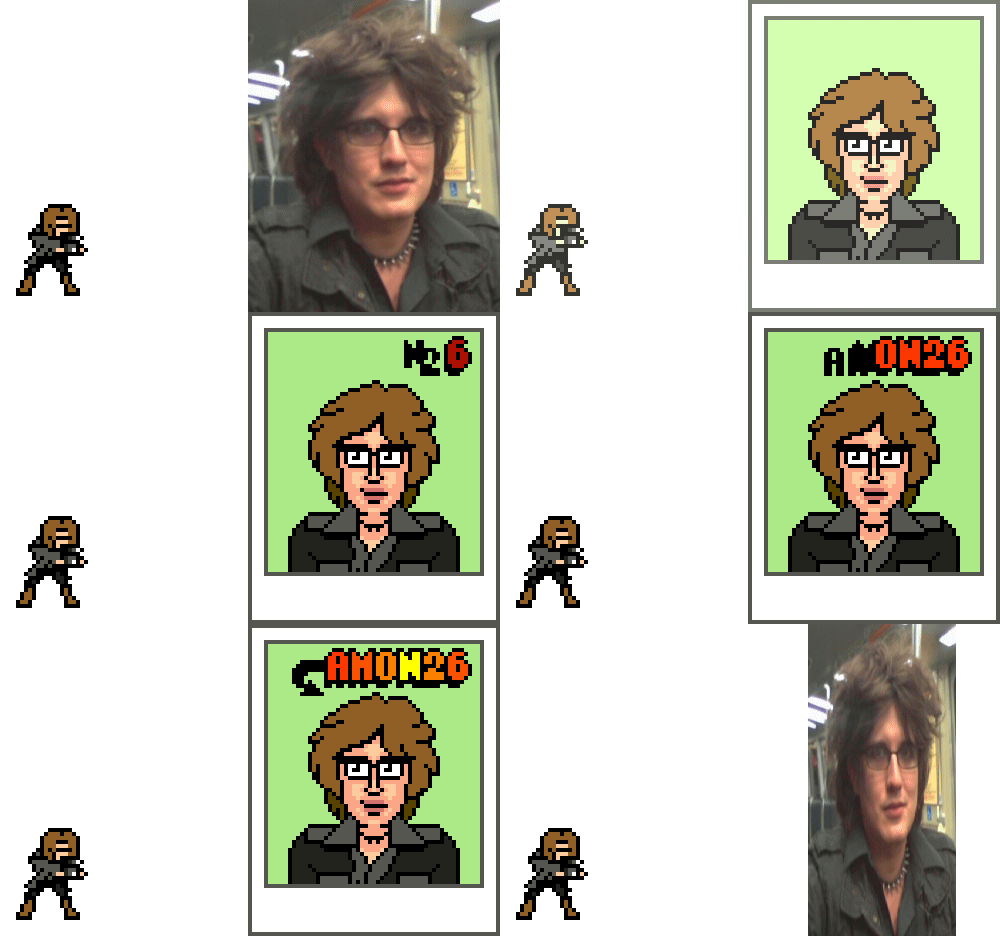
Creator Spotlight: Amon26


            Okay...so, in an attempt to provide more content in less time, as well as a chance to branch out and try to discuss things not as terribly depressing as the state of the games industry, I want to talk about creators.  Game developers, composers, programmers, what have you, who I think need more exposure.  I don't know who reads my blog or who even cares, but...this is me paying my respects.

            I had originally planned to start with a fantastic composer, one of the only ones to ever make me cry, but instead I want to talk about horror.  Delicious, fun, soul chilling horror.  Believe me, this is going to be good.  This is Amon26.

Pretty amazing developer overall.  I have no idea why more people don't know him.
            I can tell you that I've never met Amon26 or even had contact with him, yet his work has been one of the most brilliant I've ever seen in the medium of Flash.  Amon26 typically works in flash games, but they...they have more polish, beauty, and mad genius than many AAA titles.

            For those who only play console games or only play games on Steam, there is a world of free games on Newgrounds, Kongregate, or any other number of flash game websites.  People create and share, for no other reason than to get experience, get their name out there, or to make others happy.  This is how Amon26 introduced himself to the gaming world at large.  He may have begun tinkering in game design around 2009, but Amon26 got his first major hit, and well deserved recognition, with Gyossait on Newgrounds in 2011.

Prepare for a beautiful nightmare.
            Gyossait is a game that is...difficult to describe at the best of times.  It has very little exposition and while Amon26 did give a cheat sheet on the story after many requests, it's best played first without it, then with it...because the experience is different each time.  Basically, the player appears, bled out of the skull of a fallen god, and begins a journey.  However something or someone is haunting him.  Trees full of blades, with flowers of blood are your waypoints and as you die, you are rebirthed to suffer, again and again until you persevere.  This is not mercy.  This is torture.  The one hounding you wishes to peel of your skin and wear it as a mantle to keep them warm at night.  All this, in the first minute or two of the game, told through only a few lines of text and the games visuals and playstyle.

Are you afraid yet?  ...you should be.
            This is why I wanted to spotlight Amon26.  His games are a perfect marriage of aesthetics and gameplay to create organic storytelling.  True, there are cryptic snippets of text that appear on the screen, but they do not exposit.  They are more like conversations half finished...things that you need to know, but you have no context for.  The true story is told through the world and how you interact with it.  At the start, you cannot kill.  You only have a shield and your wits to overcome enemies and puzzles.  However, one puzzle inadvertently kills someone...and from then on, you are allowed to kill.  You are given a gun, but never told to use it.  You can, at points, return to only your shield.  How you play with this affects both the ending and your experience.  Are you a destroyer, who will take the easy way out, or have you learned the value of life through your mistake?  These deep ideas are what a little organic storytelling can create.

This is about all the exposition you're gonna get before Gyossait starts.
This is about all the exposition you'll get in game.  Tell me that's not unsettling.  I dare you.
            However, let's talk about the visuals for a second.  Amon26, in an interview with Indiegamemag.com, spoke of how he had nightmares, vivid dreams of creatures half formed, believing themselves to be human, or perhaps jealous of our own humanity, and wishing to take it by force.  Monsters birthed not from some unspeakable Lovecraftian pit, but from the human mind...and these nightmares are the source for much of Amon26's visuals.  Gyossait is a ruined world, on the verge of collapse.  Monsters roam the streets, the bleakness is like a nightmare made manifest, and the first time you meet your "host," after she kills you only to taunt you and revive you for more suffering, you will understand horror.  It is not an adrenaline rush from a quick jump scare.  It is the knowledge that your life is in another's hands...they hate you...but they don't want you to die...they want you to suffer.  The world hates you and this hate is heaped upon you like a leaden net to weigh you down.  It is this atmosphere that makes playing Gyossait distinctly uncomfortable, but also engrossing.  Because you're not alone and being hunted.  You are in a living, breathing world that is apathetic at best and at its worst, cruel to a fault.

Nightmare fuel.  Delicious, beautiful nightmare fuel.
            I don't intend to spoil Gyossait's plot or endings, but this game is how I was introduced to Amon26.  His previous titles, All of Our Friends are Dead, a shooting game that had no story, but piled on the unsettling atmosphere in such a way that it felt like a nightmarish fever dream, and Au Sable, following a girl in a red hood, journeying into a deep dark forest, in search of her sister and finding the remnants of what once was human hunting, taunting, and crying, are equally unsettling.  Amon26 has a talent for creating stories that only need a little exposition before allowing the game design and visuals to take you on a journey.  I'd even go so far as to call him video gaming's Edgar Allen Poe.  Not widely appreciated in his time, but amazing in what he has done with so little.

All of Our Friends Are Dead.  True terror lies not in graphics, gore, or music, but in the unsettling nightmares we make for ourselves.  If a developer gives you the pen, you know you've got good horror.
          Ironically, Amon26's games aren't all grim or bleak.  His current project, Shomia Teaf, focuses on a fairy in a colorful world and seems far more lighthearted...however, there is an undertone of something being very wrong, as the violence in the game suggests.  Let's Win Forever is another game that is bright and colorful, but...feels distinctly off.  I can't even describe this thing.

Let's Win Forever.  I don't even know, but something seems...off.
            Amon26 is a one man development group and despite numerous setbacks, continues working towards not wealth, but some semblance of happiness.  He enjoys what he does and believes in himself, but...for all that I've sold him as some dark, brooding, angsty, tosser, he's actually much more like Justin Carmical than you'd think.  Amon26 does suffer from some personal demons.  Don't we all.  However, despite that, he tends to focus on the positive.  In his interviews, he always encourages people to follow their own path.  If they don't know what they want to do, strike out and do anything.  Don't let others dictate who or what you should be and don't ever think you're not worth something.  Amon26 is an odd character whom I've never met, but would someday like to.  His games show more intelligent design than dozens of AAA titles I've ever played with their sole issue being their brevity.  Gyossait and Au Sable each are likely beatable in under an hour.  However, I don't want that to discourage people.  They are games I feel everyone should experience, both for their own nightmare fuel, but also because they really are fascinating looks at how a story is formed not necessarily by exposition, but by the actions of the player in an unusual situation.

Au Sable.  You go into the woods looking for Harmonia and find something inhuman...or perhaps too human.
            Here's where things get a little odd, though.  Yes, just here.  Shut up.  Amon26 is what many on the internet might call, a digital wayfarer or vagrant.  His only wiki is on the independent games wiki, which does not have links for many of his games and even though it gives links to websites or what have you, most are abandoned or reverted to their regular domain name owners.  The man is hard to pin down.  The best way to look into him, however, is probably through his twitter and his tumblr, both becoming outlets for personal discussion on his journey through life and on his games.  Amon26, though still a relative unknown in the game development community, is a person worth watching.  He hasn't published games to any widely known platforms however he continues to develop because it is what he loves.

            I would encourage everyone to at least give Amon26 and his games, particularly Gyossait, a look.  Support him if you can.  Spread word of his games.  Follow him on twitter or tumblr.  Look into his youtube account.  Check out his music on bandcamp.  If you wish to donate, he's given instructions here.  More than anything though, try his games, many of which even I haven't tried...yet...anyway, they all have his signature style.  So give them a look.  And, while still free on Newgrounds, Amon26 has assembled a deluxe edition of Gyossait for sale, including bonus content in the form of mp3s, Au Sable, All of Our Friends Are Dead, and a prequel to Au Sable, The Hunt, where you take on his imagined horrors in a first person, Doom-style, shooter.  You can purchase that here.

The Gyossait Deluxe Pack has tons of extra...the Hunt is a prequel to Au Sable and it's just as terrifying.
            In spite of my plugging, this is meant not as a publicity tool, but a sign of heartfelt respect for Amon26, as someone who likes a certain brand of horror...his brand.  The kind that doesn't beat you over the head with musical stings or overwrought exposition, but which is quiet, cerebral, tense, and unsettling.

            Wherever you are, Amon26, you've got at least one fan here.